Aftershock 2025: The Ruckus, The Roar, The Resurrection
The 13th annual Aftershock Festival detonated at Discovery Park in Sacramento from October 2–5, 2025 — and it didn’t just rise up. It exploded. Over four days, more than 164,000 fans descended from across the country and around the world to witness what many are already calling the biggest Aftershock yet. It wasn’t just a concert series — it was a four-day collision of chaos, sweat, nostalgia, and unfiltered musical violence.
What followed was four days of sonic brutality and four nights of cathartic release: a celebration of rock, punk, and metal, where nostalgia and rebellion locked arms. This is the Aftershock Festival 2025 review through Metal Mantra’s eyes — messy, loud, and absolutely alive.
Day One — Pop-Punk Shock & Metal’s Back Alleys
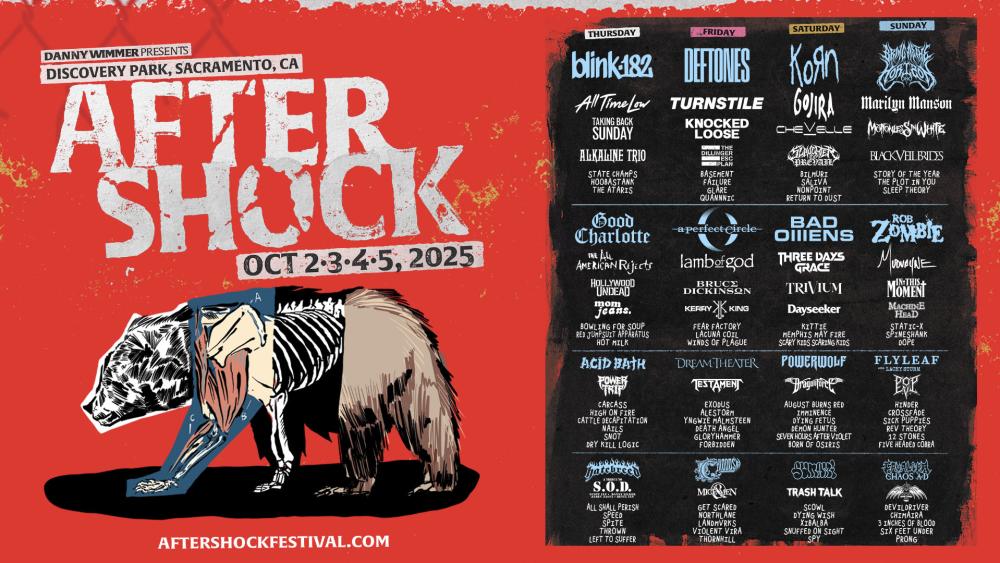
Thursday’s opening salvo leaned hard into pop-punk nostalgia while quietly loading the side stages with serious heaviness. The main-stage Aftershock 2025 lineup for Day One read like a warped early-2000s mixtape: Blink-182 reigning as headliners, flanked by Good Charlotte, All Time Low, Taking Back Sunday, and The All-American Rejects. It was a full-frontal assault of hooks, harmonies, and heartbreak lyrics yelled back by thousands of fans who grew up on warped-tour summers and burned CD-Rs.
Blink-182’s headlining set felt like a time capsule smashed open and reassembled at maximum volume. Anthems like “All the Small Things,” “Feeling This,” and “What’s My Age Again?” hit with familiar impact, while newer material proved the band has more in the tank than just nostalgia. Between off-color jokes and crowd-wide singalongs, the headliners turned Discovery Park into a communal therapy session for aging punks and wide-eyed newcomers alike.
But this is Aftershock — pop-punk was only half the story. Dive off the main drag and the festival’s metal DNA was very much alive in the shadows. Side stages churned with heavier acts: Carcass ripped through surgical death-metal riffs; Cattle Decapitation delivered a suffocating wall of grind and death; High on Fire smoked the air with thick, doom-soaked guitar tone; and Nails detonated short, vicious bursts of hardcore violence. For fans tracking the heavier end of the Aftershock 2025 lineup, Day One was already a win.
Hardcore and crossover fans got theirs too. Bands like Hatebreed turned circles of mud into tidal-wave pits, barking along to breakdown-ready anthems and turning the festival grounds into a training ground for the rest of the weekend. It was the perfect balance: main-stage pop-punk melodies on one side, underground chaos on the other. The message was clear — Aftershock 2025 wasn’t just for one subgenre tribe. It was for all of them.
Rain rolled in early and turned the park into a sloppy battlefield, but nobody flinched. Ponchos, trash bags, soaked hoodies and smeared eyeliner became part of the uniform. Fans trudged through ankle-deep muck to make it to the barricade, to catch that next chorus, that next breakdown. The weather tried to drown Day One; the crowd simply roared back louder.
Day Two — Homecoming, Bay-Area Thrash & Metal Legacy
Friday dialed down the sugar and turned up the weight. If Day One was a grin, Day Two was a clenched jaw. At the center of it all were Sacramento’s own Deftones, turning Aftershock 2025 into a full-on hometown ritual. From the moment they hit the stage, the air changed — thick with anticipation, history, and the kind of love only a hometown crowd can radiate.
Deftones built a career-spanning set, gliding from the dreamlike haze of “Digital Bath” to the feral stomp of “My Own Summer (Shove It)” and the crushing weight of “Diamond Eyes.” When epic cuts washed over the crowd, you could feel thousands of voices rising in unison — a generation that grew older but never outgrew the band. This wasn’t just a headline set; it was a community exhale, a shared moment between a band and the city that raised them.
The rest of the Day Two Aftershock 2025 lineup kept things dynamic and dangerous. A Perfect Circle delivered sleek, surgical alt-rock on the main stage — an exercise in tension, melody, and restraint amid the festival chaos. Turnstile lit up the crowd with their hyperactive, groove-soaked hardcore, turning the pit into a trampoline of bodies and sweaty grins. Knocked Loose barreled through one of the most violent sets of the weekend, conjuring breakdowns that hit like steel-toed boots to the chest.
But Friday had more than just groove and hardcore — it dug deep into thrash and Bay Area metal roots too. Old-school fans got their fix with legendary Bay Area thrash icons like Death Angel and Exodus tearing up the undercard stages. Their presence added a gritty nod to the region’s metal legacy, reminding everyone that Aftershock isn’t just about flash — it’s about roots, thrash history, and heavy metal’s long memory.
Metal traditionalists and prog-heads got their fix too. Lamb of God unleashed a textbook lesson in groove-metal, all whiplash riffs and razor-sharp precision, while Dream Theater bent time, tempo, and minds with labyrinthine prog epics. In between, you could catch everything from sludgy post-metal to classic-thrash revival, as bands rotated through stages like a living museum of heavy music’s evolution.
By the time the lights went down on Day Two, one thing was obvious: Aftershock 2025 wasn’t coasting on big names alone. It was curating moods. Deftones may have been the emotional anchor — the headliners who turned the park into a cathedral — but every band that touched Friday’s stages helped write the next chapter of the festival’s legacy.
Day Three — Nu-Metal Bullets & Underground Fury
Saturday was built for chaos. If you came to Aftershock 2025 for nu-metal, this was your day to bleed. Korn took command of the main stage with a set that felt like a livewire plugged straight into 1999 and dragged screaming into the present. From the first lurching bassline of “Blind” to the twisted bounce of “Freak on a Leash,” the band delivered a reminder of why they’re still at the top of the nu-metal food chain.
Jonathan Davis stalked the stage like a man possessed, his vocals shifting from guttural growls to desperate wails, while the band’s downtuned crunch turned the lawn into a heaving ocean of bodies. Old-school fans got their nostalgia overload; newer converts got baptized by dust, sweat, and riff. For many, this was the high point of the entire Aftershock Festival 2025 — the moment where anticipation, nostalgia, and live energy collided at full speed.
Korn didn’t carry Saturday alone. Gojira shook the earth with their titanic, eco-apocalyptic groove metal, each riff landing like an artillery shell. Chevelle kept the alt-metal torch burning with tight, melodic heaviness. Bad Omens brought a modern, sleek, almost cinematic edge to the lineup, pulling in younger fans and proving that contemporary metalcore belongs on big festival stages.
Away from the marquee names, Saturday’s undercard was a gauntlet. Deathcore units roared through sub-harmonic breakdowns; blackened thrash outfits spat out high-speed venom; hardcore bands turned smaller pits into boiling cauldrons of stagedives and pile-ons. Fans bounced between stages chasing the next riff, the next scream, the next chance to throw themselves into the fray.
By the end of Day Three, everyone was running on fumes and adrenaline. Voices were shot, necks were wrecked, and shoes were barely hanging together, but nobody slowed down. If Aftershock 2025 had a single word to define Saturday, it was simple: relentless.
Day Four — Apocalypse, Mayhem & Triumphant Closure
Sunday arrived with that weird mix of exhaustion and “one more day” desperation — and Aftershock 2025 answered with one of its most adventurous headliners. Bring Me The Horizon closed out the festival with a set that felt like a hybrid of metalcore, arena rock, and dystopian rave. Lasers cut through the night, massive choruses crashed over the crowd, and thousands of voices chanted every hook like a cult hymn.
From older cuts to newer, genre-bending tracks, BMTH treated the Aftershock 2025 lineup like a playground. “Shadow Moses,” “Throne,” and other fan-favorites detonated across the park, while newer, more experimental material showcased the band’s evolution into one of modern heavy music’s most divisive — and undeniable — forces. It was theatrical, bombastic, and unapologetically over the top, the exact kind of spectacle a four-day festival closer should be.
The rest of Day Four kept the needle buried in the red. Rob Zombie rolled in with horror-metal theatrics, zombie-flick visuals and carnival-of-the-damned energy. Marilyn Manson surfaced with a bruised, grimy industrial stomp that felt like a ghost of shock rock’s past grinding against the present. Mudvayne brought mathy, groove-loaded chaos, while Machine Head carved through tightly wound thrash and groove-metal epics that had the diehards losing their minds one last time.
As Sunday night wore on, there was this sense of collective burnout and triumph. Fans slumped between sets, grabbing water and air, only to surge back to life when the next band launched into their opening riff. When Bring Me The Horizon’s final notes faded into the Sacramento night, it didn’t feel like the end. It felt like the closing chapter of a story you’ll be replaying in your head for months.
Mud, Mayhem & Metal Community
No festival is perfect, and Aftershock 2025 made zero attempts to hide its rough edges. Rain turned sections of Discovery Park into mud pits, lines snaked for food and merch, and every square foot of shade was contested territory. But that’s the deal — you don’t come to a four-day heavy music festival for comfort. You come to survive it.
Through the inconvenience and exhaustion, what stood out was the community. Kids in oversized band tees and noise-canceling headphones sat on parents’ shoulders, seeing their first screamers and shredders. Old-school lifers in battle vests compared patches with Gen-Z hardcore kids. Strangers pulled each other off the ground in the pit, shared water, shared set recommendations, shared earplugs and inside jokes.
The real heart of Aftershock Festival 2025 wasn’t just the lineup — it was that sense of “we’re in this together.” Muddy shoes, bruised ribs, sunburnt faces, blown-out voices — all badges of honor from four days spent chasing the next riff, the next song, the next moment where the outside world fell away and only the music remained.
Resurrection, Not Just Another Festival
Aftershock 2025 wasn’t just another festival. It was a resurrection — of nuked-out mosh pits, of pop-punk and nu-metal nostalgia, of metal tradition, of sweaty camaraderie, and that raw, unpretty love for loud guitars and primal screams. It felt familiar but never safe, brutal but strangely hopeful, chaotic but absolutely necessary.
If you found yourself drenched in sweat at the barricade, limping back to your car with ringing ears, or simply standing back and watching generations collide to the sound of distortion, you didn’t just attend Aftershock 2025. You endured it. You lived it. And a piece of it is going to live in you for a long time.
Missed it? That’s on you. But there’s always next year. The whispers around Aftershock 2026 have already started, growing louder with every replay of this year’s memories. If 2025 proved anything, it’s this: Sacramento’s loudest weekend is nowhere near done with us — and we’re definitely not done with it.