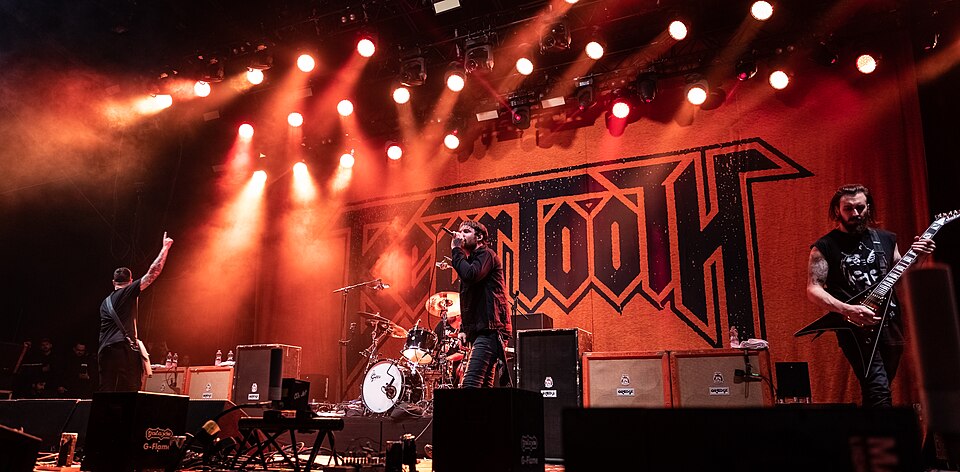
There is a conversation happening in metalcore right now, and most people are dancing around it. Two of the genre’s most significant acts — Beartooth and Atreyu — are actively moving away from the sound that built them. Not drifting. Not softening by accident. Moving, deliberately, with intention. The question the scene needs to answer is simple: is this growth, or is this goodbye?
The Blueprint Already Exists
Before unpacking Beartooth and Atreyu specifically, acknowledge the obvious precedent. Bring Me The Horizon did this years ago — and did it loudly. They went from deathcore brutality to stadium-ready synth-pop, and the metal world spent half a decade arguing about it. Some called it evolution. Some called it sellout. History has largely sided with “evolution,” given that BMTH is now one of the biggest rock acts on the planet.
That template matters. It tells us that genre departure, when executed with genuine artistic conviction, can work. It also raises the bar for any band that follows the same path. You don’t get to drift toward accessibility and call it vision unless you actually have one.
Beartooth: The Surface Was Already a Warning
Caleb Shomo built Beartooth on a foundation of cathartic, brutally honest metalcore. The early records — Disgusting, Aggressive — were raw, visceral, and unapologetically heavy. That sound connected because it was real. Shomo was writing from a dark place, and the music reflected it.
Then The Surface arrived in 2023 and the shift was already underway. The record debuted at No. 1 on Billboard’s Hard Rock Albums chart, spawned consecutive Active Rock radio No. 1 singles, and accumulated streams by the hundreds of millions. It also sounded like a band testing the edges of their own genre identity. Now, in early 2026, Beartooth has signed with Fearless Records and released “Free” — the first single from a new album cycle. Shomo co-wrote and co-produced it with Jordan Fish (the same Jordan Fish who helped architect BMTH’s pop pivot). The track leans into soaring melody, emotional accessibility, and clean rock dynamics. Subtle nods to the heavier roots remain, but they are exactly that — subtle.
Shomo describes “Free” as the most personal material he has ever written. He frames the new era around clarity and emotional honesty rather than darkness and chaos. That is a meaningful creative shift. The band is no longer writing from the pit — they are writing from somewhere that requires a different kind of sound to express it.
That is not a criticism. But it is a fact the metalcore audience needs to sit with. Bands like Knocked Loose are currently occupying the extreme end of the genre spectrum with zero compromise. The space Beartooth is vacating will not go empty. Someone else will fill it.
Atreyu: Going Heavier Is Still Going Somewhere Different
Atreyu’s trajectory is more complicated, and in some ways more interesting. Where Beartooth is clearly moving toward accessibility, Atreyu is swinging in the opposite direction — toward something rawer and heavier than their recent catalog. Frontman Brandon Saller revealed that the band implemented a strict rule during the writing of their upcoming 2026 record: no music written within the last ten years was allowed in the room. Only records at least a decade old.
The result, Saller says, is music directly influenced by the bands that shaped them — Hatebreed, Soilwork, In Flames, local hardcore acts. He promises some of the heaviest material Atreyu has ever written. That’s a significant statement from a band that made their name blending metalcore with melodic hooks and screamed-clean vocal dynamics on records like The Curse and A Death-Grip on Yesterday.
The single “Dead,” released in late 2025, hints at this direction — aggressive, direct, stripped of the more ornamental elements that defined their mid-career work. The re-recorded version of The Curse, rebuilt without founding vocalist Alex Varkatzas and produced by Kellen McGregor of Memphis May Fire, was simultaneously a celebration of their legacy and a signal that the band is redefining what Atreyu sounds like on their own terms.
Here is where the nuance matters: going heavier is still evolution. Atreyu is not returning to The Curse era. They are using old influences as a compass to navigate toward something new. That is not nostalgia — that is deliberate artistic recalibration. In a scene where newer metalcore acts like Wage War are constantly evolving their own formula, Atreyu’s move back toward aggression is its own kind of departure from expectation.
What This Actually Means for the Genre
Here is the real conversation: metalcore is not a holding tank. Bands grow, change, and move on. The genre itself has always been a transitional space — artists arrive through hardcore or metal, find the middle ground, build an audience, and then keep moving. That movement is not betrayal. It is the natural life cycle of a band with ambition.
What changes when significant acts like Beartooth and Atreyu make these moves is the shape of the genre’s center of gravity. The sound that made them famous — that specific intersection of breakdowns, melodic choruses, emotional candor, and screamed vocals — gets left with whoever is still committed to it. Right now, that is a healthy list of acts. But the genre loses something when its most visible names exit the room, even voluntarily.
The concern is not that Beartooth sounds more like rock and Atreyu sounds more like hardcore. The concern is whether the next generation of metalcore bands has the ceiling that Beartooth and Atreyu occupied. Those bands proved you could build a real career in this genre. Their departure upward — or sideways, or wherever — changes what young bands see when they look at the top of the ladder.
Growth Does Not Require an Apology
The position here is clear: Beartooth and Atreyu have earned the right to make whatever music they need to make. Shomo built one of the most emotionally resonant catalogs in modern heavy music. Atreyu survived lineup upheaval, a hiatus, and two decades of genre evolution without losing relevance. These are not bands abandoning ship. These are bands steering.
Whether you follow them depends entirely on what you came for. If you came for Caleb Shomo’s voice and his unflinching willingness to put his mental state on record, “Free” is still delivering that — just with a cleaner vehicle. If you came for Atreyu’s aggression and the particular electricity of their early records, the 2026 album might surprise you in the right direction.
But if you came specifically for metalcore as a sound — the breakdowns, the screams, the structural DNA of the genre — then you need to look elsewhere. These bands are no longer the destination. They are proof that the destination existed, and that it was worth building from.
That is not abandonment. That is what growth actually looks like from the outside when it is uncomfortable.