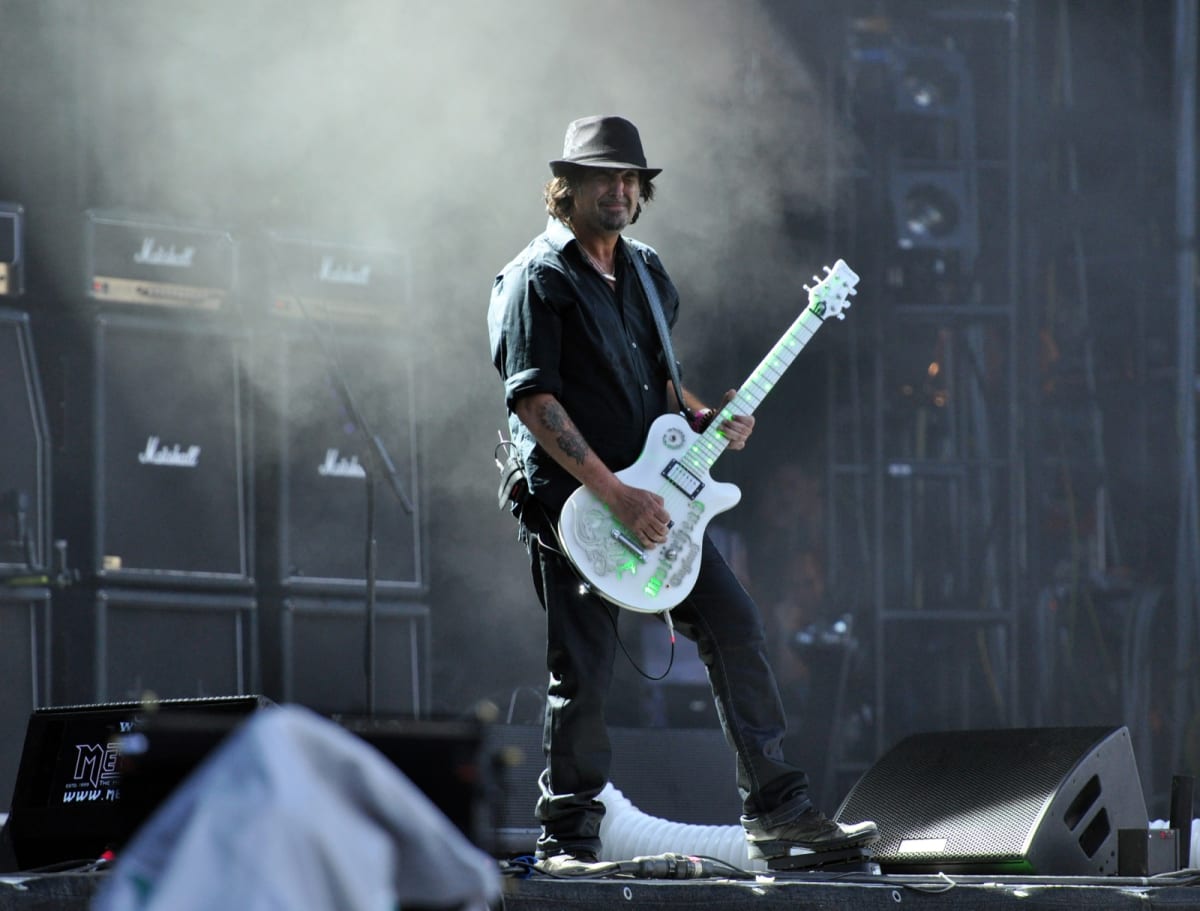
Phil Campbell is dead.
The Welsh guitarist who spent 31 years as the engine room behind Motörhead's wall of sound died peacefully at age 64, following what his family described as "a long and courageous battle in intensive care after a complex major operation." No specific cause was given. No details were added beyond what the family chose to share. That's their right. The music speaks everything else.
Campbell's death was announced by his sons — Todd, Dane, and Tyla — via Phil Campbell and the Bastard Sons' social media on March 14. Motörhead's official account followed with a statement that cut straight to the heart: "Phil was a wonderful guitarist, writer, performer, and musician who had Motörhead in his veins." The statement went further, capturing something essential about the man: "Phil led with his heart. You could not be around him without a chuckle or 20, because quite simply, Phil loved life and lived it with great joy."
That portrait — the joyful man, the one laughing in the middle of the loudest band on earth — tracks with everything anyone who crossed paths with Campbell ever said about him.
Thirty-One Years on the Front Line
Philip Anthony Campbell was born on May 7, 1961 in Pontypridd, Wales. He joined Motörhead in 1984, becoming one of two guitarists alongside Michael "Würzel" Burston on the No Remorse compilation and then the Orgasmatron album in 1986. When Würzel departed in 1995, Campbell became the sole guitarist for the final two decades of Motörhead's existence.
Think about what that means. For 20 years, every riff, every solo, every grinding chord under Lemmy's bass and Mikkey Dee's drums came from Phil Campbell. He wasn't just a member. He was the other half of the engine.
He played on 16 Motörhead studio albums. He co-wrote some of the band's most durable material — "Killed by Death," "Rock Out," and dozens of others across a discography that spanned from No Remorse all the way to Bad Magic in 2015, the last record the band would ever release.
That Bad Magic chapter still stings. Lemmy was in visible decline by then — losing weight, struggling on stage, playing shorter sets. Campbell showed up every night regardless, playing his parts at full volume while the frontman he'd spent his career alongside was clearly running out of time. Motörhead played their final show on December 11, 2015 at the Zenith in Munich. Lemmy was dead 16 days later.
Campbell, by multiple accounts, did not get the chance to say goodbye. Lemmy had wanted to keep touring. Nobody was allowed to tell him otherwise. Campbell learned about his death the same way everyone else did.
The Grammy, the Legacy, the Record
In 2005, Motörhead won the Grammy Award for Best Metal Performance for their cover of Metallica's "Whiplash." Phil Campbell was on stage when they accepted it — a moment he repeatedly described as one of the high points of his career. He said, not quite deadpan, that it was "pretty cool."
That's the kind of understatement that tells you everything. A Grammy is a validation mechanism for people who need external validation. Campbell had been in Motörhead for 21 years by then. He didn't need anything confirmed.
He was nominated alongside the band multiple times across different eras — in 1992 for 1916, in 2000 for their "Enter Sandman" cover, again in 2015 for "Heartbreaker." Those nominations trace a timeline through 25 years of consistent heavy metal output at the highest level. Not many careers can claim that kind of staying power in a genre that eats its own.
By the time Motörhead dissolved, he was the longest-serving member aside from Lemmy himself. That distinction mattered. Phil Campbell was not a hired gun. He was, after Lemmy, the constant.
After the End, the Bastard Sons
When Motörhead ended, a lesser musician might have retired. Phil Campbell turned it into a family band.
Phil Campbell and the Bastard Sons launched with his three sons — Todd on guitar, Dane on guitar, and Tyla on drums — and quickly established themselves as more than a nostalgia vehicle. The band released The Age of Absurdity in 2018 and Kings of the Asylum in 2023, both of which demonstrated that Campbell still had something to say beyond Motörhead classics. He also released a solo album, Old Lions Still Roar, in 2019 — the kind of title that ages into prophecy.
The Bastard Sons played sell-out shows. They played Motörhead material and original songs with equal conviction. They played the Muni arts centre in Pontypridd, Campbell's hometown, to a sold-out room. That last detail matters. He came home to his people, his three sons on stage beside him, and packed the house.
A 2026 tour of Australia and Europe had been cancelled earlier in the year due to health concerns. That cancellation was the first public signal that something serious was wrong. The scene noticed. The tributes that followed his death made clear how closely people had been watching and hoping.
What the Scene Lost
Mikkey Dee, who shared a stage with Campbell from 1992 through to Motörhead's final night in Munich, did not mince words in his tribute: "The funniest guy I have ever known and the best rock guitar player I have ever played with." He went on to say he hoped Campbell would "say hi to Lemmy, Würzel, Filthy and Eddie" — a reference to the Motörhead family that preceded him in death.
The full weight of that sentence takes a moment to land. Lemmy. Würzel. "Filthy" Phil Taylor. Eddie Clarke. The founding generation of Motörhead, the players who built the blueprint. And now Phil Campbell, who carried it for longer than anyone other than the man who created it.
Doro Pesch, a longtime friend, said she was "at a loss for words." That from someone who has never been at a loss for anything.
The tributes are still coming in as of this writing. They will keep coming. Phil Campbell spent 31 years in the service of one of heavy metal's most singular bands, then spent another decade proving he was more than that band. He played with joy, his family said. Motörhead confirmed it. Everyone who ever saw him play already knew it. Follow our Metal News section for ongoing coverage and tributes.
He is survived by his wife Gaynor, his three sons, and his grandchildren — who knew him as Bampi.
The world has just lost an enormous beam of light.
Phil Campbell was 64 years old. He is survived by his wife and three sons. Phil Campbell and the Bastard Sons' upcoming tour dates had been canceled prior to his death. Funeral and memorial arrangements have not been announced at this time.