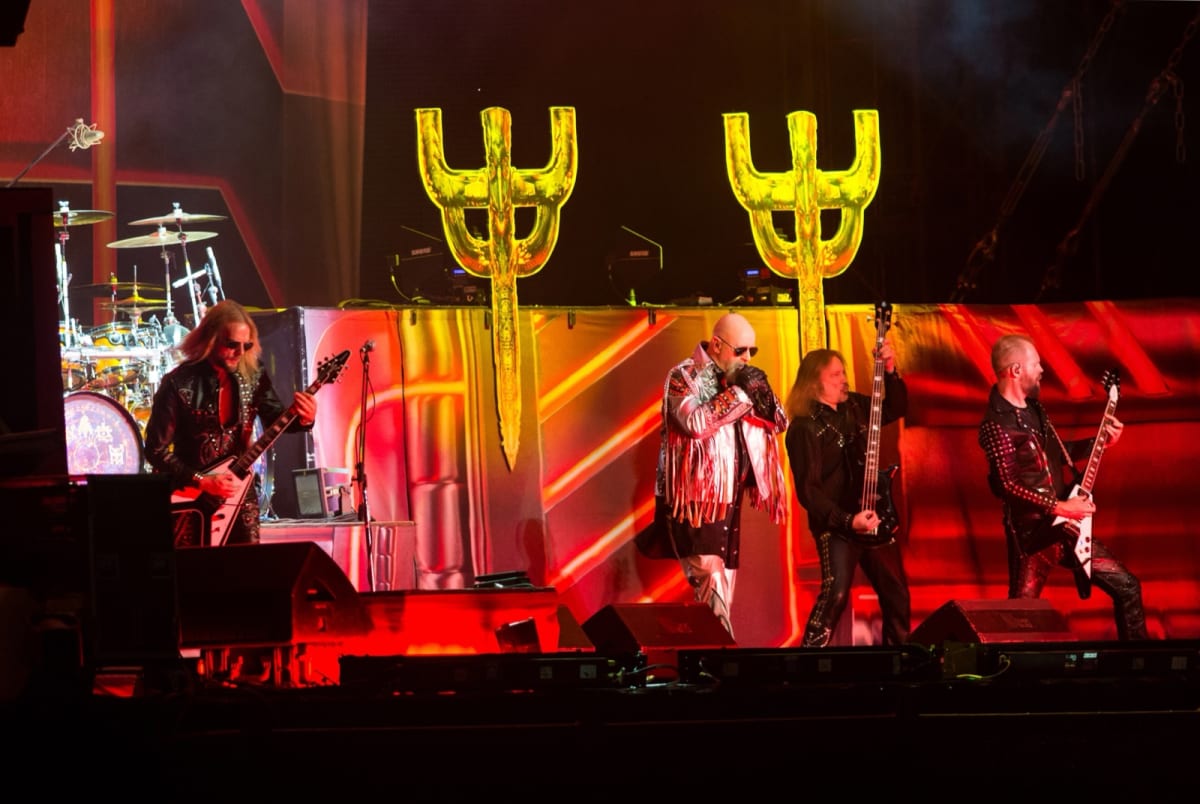
In September 2021, Richie Faulkner walked off stage at Louder Than Life in Louisville, Kentucky, and nearly died. He had been playing Judas Priest's set when his aorta split — a complete aortic dissection, one of the most immediately life-threatening cardiovascular events a person can have. Surgeons at UofL Health's Rudd Heart and Lung Center worked on him for roughly ten hours: aortic valve replacement, ascending aorta replacement, hemiarch replacement. He survived.
What nobody knew — what Faulkner himself kept quiet until a Premier Guitar interview in April 2025 and has now elaborated on further — is that the aortic dissection wasn't the end of his medical crisis. It was the beginning of a longer, more complicated story. One that's still ongoing. One that involves a stroke, brain damage, and a guitarist playing the Priest catalog every night while managing things most of his audience had no idea existed.
The Month After
About a month after his first surgery, Faulkner was walking his dog in his Nashville-area neighborhood with his girlfriend Mariah and their daughter Daisy. He felt it coming before it happened — a wave of something wrong moving through him. His face went. He couldn't speak. Mariah, who had the baby in one arm, grabbed him before he fell.
He went back to the hospital. The initial read was a TIA — a transient ischaemic attack, a mini-stroke. The TIA designation suggested the damage might not be permanent. But it wasn't a TIA. It was a stroke. Mariah believes he may have had one in the ambulance on the way in.
More incidents followed. A year later, after another open-heart surgery to address a leak, he had additional events. And then, when Judas Priest returned to the road in 2022 and he started noticing something different about his right hand while playing, the picture became clearer. Tests revealed damage on the left hemisphere of his brain — which controls the right side of the body. His picking hand. His engine room, as he puts it.
"It's not a TIA," he was told. "Stroke damage doesn't go away."
Playing Through It
What makes Faulkner's account so hard to sit with is not just the severity of what he's been managing — it's how long he managed it alone, and why.
He felt like a fraud. Every night he walked out to play with Judas Priest, a band where the standard of execution is world-class or nothing, he was aware that something wasn't right in his right hand. The rhythm patterns — the locked-in, coordinated picking that makes PRIEST sound like PRIEST — weren't coming as automatically as they always had. He'd practiced and it had gotten worse, not better. He'd changed his picks, wondering if his rings were the issue. He went through months of denial before the diagnosis confirmed what he already sensed.
"I could get through it," he said, "but there was something different."
The fear of being found out shaped every decision. He worried that fans would lose faith. That the guitar companies and string brands backing him would bail. That the trust he'd built over 15 years with Priest would crack if anyone knew his right hand was compromised. So he said nothing publicly, pushed through every show, and did three physiotherapy sessions a day — morning, pre-show, post-show — with a German physio named Bastian who travels with the band specifically to keep Faulkner's right side functioning.
"I feel like a fraud," he said, "because people don't know — maybe. But one day they're gonna find out."
He came home from bad shows and called Mariah in tears. Told her he couldn't do it. Couldn't play 'Painkiller' right. Couldn't lock into the rhythm patterns. Then had a good show, and came back out the next night and did it again.
The Decision to Talk
For nearly three years after returning to the road with Priest in 2022, Faulkner kept most of this locked down. Close friends knew. Mariah knew. Bastian the physio obviously knew. Beyond that small circle, almost nobody did.
Faulkner started opening up gradually — first in the Premier Guitar piece in 2025, now in more detail with Charlie Kendall's Metalshop. He gives two reasons for going public.
The first is personal. He needed to get it out. Playing every night knowing something was wrong, and knowing nobody in the audience knew — it was weight he couldn't keep carrying quietly. "You can't argue the truth," he said. "That's the way it is."
The second is for other musicians. Metal has never been great at this. The culture runs on toughness, on pushing through, on performing at full power even when nothing is working. Faulkner is aware of that. He's aware that musicians across genres perform while managing things nobody talks about — physical limitations, mental health struggles, fear of being exposed as less than what people paid to see. He wants them to know they're not alone in that.
"I know there's a lot of people out there that play, they sing, whatever they do, and they feel like they're not good enough or that we don't have these issues as well, and it affects your mental health," he said. "And I want them to know that they're not alone."
That's a meaningful thing to say. It's also a difficult thing to say for someone who spent years hiding exactly this kind of struggle. The honesty in the gap between what he believed and what he did — performing world-class shows in front of tens of thousands of people while managing stroke damage in his picking hand — is what makes this worth sitting with.
What It Actually Looks Like Now
Faulkner is still with Judas Priest. He's still doing three physio sessions a day on the road. The right-side impairment is real and ongoing — it affects rhythm and coordination more than the solo playing, which can be adapted. He watches his diet, manages his meds (he mentioned forgetting them during a previous interview, in a moment of genuine human detail), and works with Bastian every day to keep the right side moving.
The band is heading back out this summer. Faulkner said everyone in Priest is healthy and excited to go. Rob Halford, he noted, has said that as long as he can do it, why not keep doing it — and Faulkner seems to have landed somewhere close to the same place. Not denial. Not pretending the last five years didn't happen. But a hard-earned, deeply personal version of: why stop?
He is 46. His aortic dissection happened completely out of the blue — no prior heart history, nothing he could have anticipated. What came after was a cascade of complications that would have ended a lot of careers, and nearly ended him personally, in ways that went beyond the physical.
Context in the Scene
Faulkner's situation joins a small but significant body of stories about musicians continuing to work through serious illness. Tom Hunting of Exodus documented his own cancer battle in a way that the scene responded to powerfully. The difference here is the specific burden of performance anxiety layered on top of physical limitation — the constant fear that the audience would notice, that sponsors would pull out, that the band would be better served by someone else. That particular kind of suffering is rarely talked about openly.
The thrash world has been watching veterans like Testament and Exodus continue to operate at high levels well into their fourth and fifth decades — the Thrash of the Titans 2026 tour being the most recent example. Judas Priest, older still, is in the same conversation. Faulkner came into Priest in 2011 as the replacement for K.K. Downing; he's now been the band's guitarist for fifteen years, through two major health crises, and counting.
What he's done in that time — continuing to deliver at the level Priest demands, while managing things nobody knew about — is its own kind of resilience. He's not asking for credit. He's just asking that the people who are doing the same thing in their own lives, at whatever scale, know they're not the only ones.
That seems like the right reason to talk.
Richie Faulkner spoke with Charlie Kendall's Metalshop in the interview cited above. His earlier account of the stroke and ongoing challenges appeared in Premier Guitar in April 2025. Judas Priest returns to the road this summer.