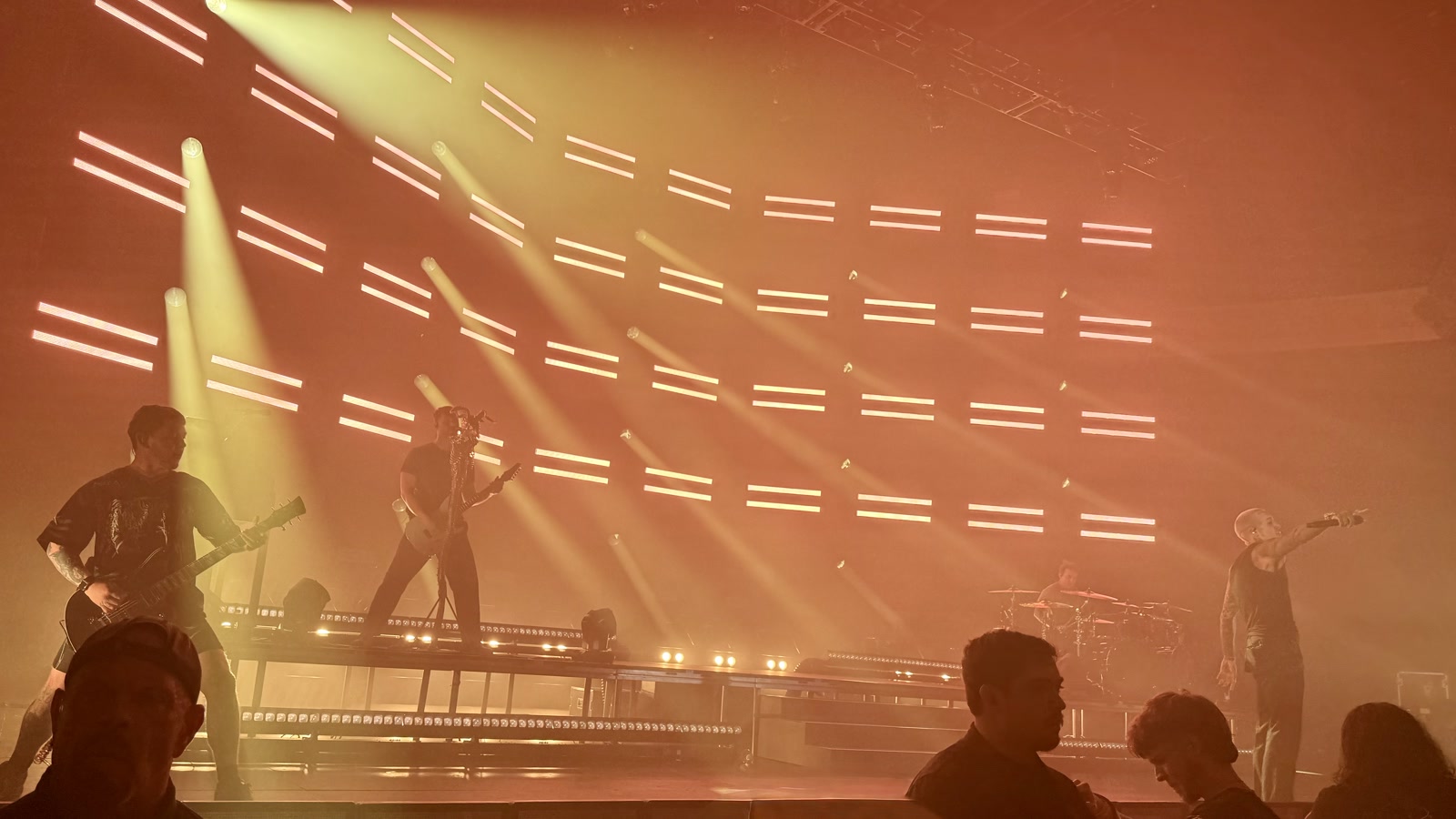
The Amity Affliction have never been subtle about pain. That has always been the point. Their best songs do not dress trauma up as poetry and ask you to admire the craft from a safe distance. They drag the thing into the room, give it a chorus big enough for a few thousand people to scream back, and let the breakdown do the rest.
House of Cards, the band’s ninth full-length, arrives with that identity fully intact, but the ground under it has shifted. This is the first Amity album with Jonathan Reeves fully in the clean-vocal slot, the first full-length after another heavy round of personal loss around Joel Birch, and another test of whether this band can keep moving without turning into its own tribute act.
The short answer: mostly, yes. House of Cards is not a reinvention, and anyone expecting Amity to suddenly burn down the blueprint is listening to the wrong band. What it does offer is a sharper, more physical version of the thing they already do well: grief turned into arena-sized metalcore, choruses built for damaged lungs, and verses that sound like Birch is trying to out-shout the collapse in real time.
This post may contain affiliate links.
Action Box: Pick up House of Cards on Amazon | Get The Amity Affliction tickets
A new era without pretending it is a new band
The biggest variable here is Reeves. Replacing a familiar clean voice in a band this chorus-dependent is not a minor lineup note. It changes the emotional temperature of the songs. On House of Cards, Reeves does not try to erase the band’s past or cosplay old dynamics. He brings a heavier, slightly rougher melodic presence, and that helps the record avoid feeling like Amity-by-template karaoke.
That matters because the template is still very visible. Songs like “House of Cards,” “Bleed,” and “Break These Chains” move with the recognizable Amity architecture: Birch detonates the wound, the chorus opens the ceiling, the guitars keep everything surging forward, and the rhythm section makes sure the pit has a job to do. The difference is that the album sounds less interested in polishing those parts into radio bait. Even when the hooks are clean, the record keeps dirt under its nails.
That is where Dan Brown’s role as producer becomes important. House of Cards does not sound overdesigned. The guitars have enough width to make the choruses land, but the record is strongest when it remembers that Amity’s emotional weight needs pressure, not gloss. “Eternal War” pushes into some of the band’s heaviest territory, and “Kickboxer” carries the kind of blunt-force momentum that keeps the album from sinking into pure confession.
Grief, collapse, and the cost of staying alive
The album’s central image is right there in the title. A house of cards does not fall because one card is weak. It falls because the whole structure was fragile from the start. That is the lane Birch works in across this record: family damage, addiction, survival, grief, and the exhausting discipline of not letting the worst parts of your life become the only parts that define you.
This is why House of Cards works even when it leans into familiar Amity emotional territory. The writing does not feel like aesthetic misery. It feels lived-in, which has always separated this band from metalcore acts that borrow darkness because it looks good on a hoodie. Birch’s delivery still has that scraped-raw directness, and the album is at its best when it lets him sound ugly, cornered, and pissed off instead of smoothing every edge for maximum singalong value.
“All That I Remember” hits that nerve directly, pulling from grief and fractured family ties without turning the subject into cheap melodrama. “Beso De La Muerte” and “Swan Dive” work in the same emotional weather, but the record avoids becoming one long grey room because Amity still know how to build release into the structure. The choruses are not escape hatches. They are pressure valves.
That is also where the album fits into the bigger Amity arc. The band’s earlier *House of Cards* announcement made it clear this record was tied to a new chapter, not just another release cycle. After Not Without My Ghosts, after the lineup change, after another round of online noise, Amity could have either retreated into safe self-imitation or overcorrected into forced reinvention. House of Cards lands somewhere more useful: familiar, but not frozen.
Where the record stumbles
The downside is that familiarity still has a cost. There are moments where House of Cards becomes exactly what skeptics accuse Amity of being: a band returning to the same emotional angles with slightly different lighting. “Heaven Sent” and “Afterlife” are solid, but they do not hit with the same authority as the album’s strongest cuts. They keep the record moving, but they do not fully deepen it.
That is not a fatal problem. Metalcore has always lived on repetition when the conviction is real. The issue is that Amity’s best material sets a high bar for catharsis. When a song does not reach it, the machinery becomes easier to hear: the drop, the hook, the crash back into the verse, the big emotional lift. On a weaker Amity record, that can feel like autopilot. On House of Cards, it mostly feels like a veteran band trusting muscle memory, sometimes a little too much.
Still, the record has enough teeth to justify itself. It also lands at a good time for the band’s audience. There is a reason Amity still matter in a metalcore landscape that has splintered into ultra-polished arena acts, deathcore crossover bands, and TikTok-ready breakdown merchants. They still understand the emotional contract. Fans do not come to this band for mystery. They come because the songs say the quiet part loudly.
That also gives this review a useful internal lane next to Metal Mantra’s broader metalcore coverage, from our best metalcore albums for beginners guide to the band’s 2026 tour with August Burns Red. House of Cards is not a beginner’s landmark like Let the Ocean Take Me, but it is a credible late-era statement from a band that still knows exactly who needs these songs.
Verdict
House of Cards is not The Amity Affliction tearing up the map. It is The Amity Affliction standing in the wreckage, checking the exits, and deciding to keep swinging anyway. The best songs hit with the old emotional immediacy while Reeves gives the clean-vocal side a necessary new shape. The weaker stretches are familiar rather than embarrassing, and the album’s conviction carries it through the places where the formula shows.
For a band more than two decades deep, that is no small thing. House of Cards sounds like survival without the victory-lap bullshit: bruised, direct, occasionally predictable, but still capable of turning pain into something a room full of people can throw back at the stage.
Score: 7.5/10