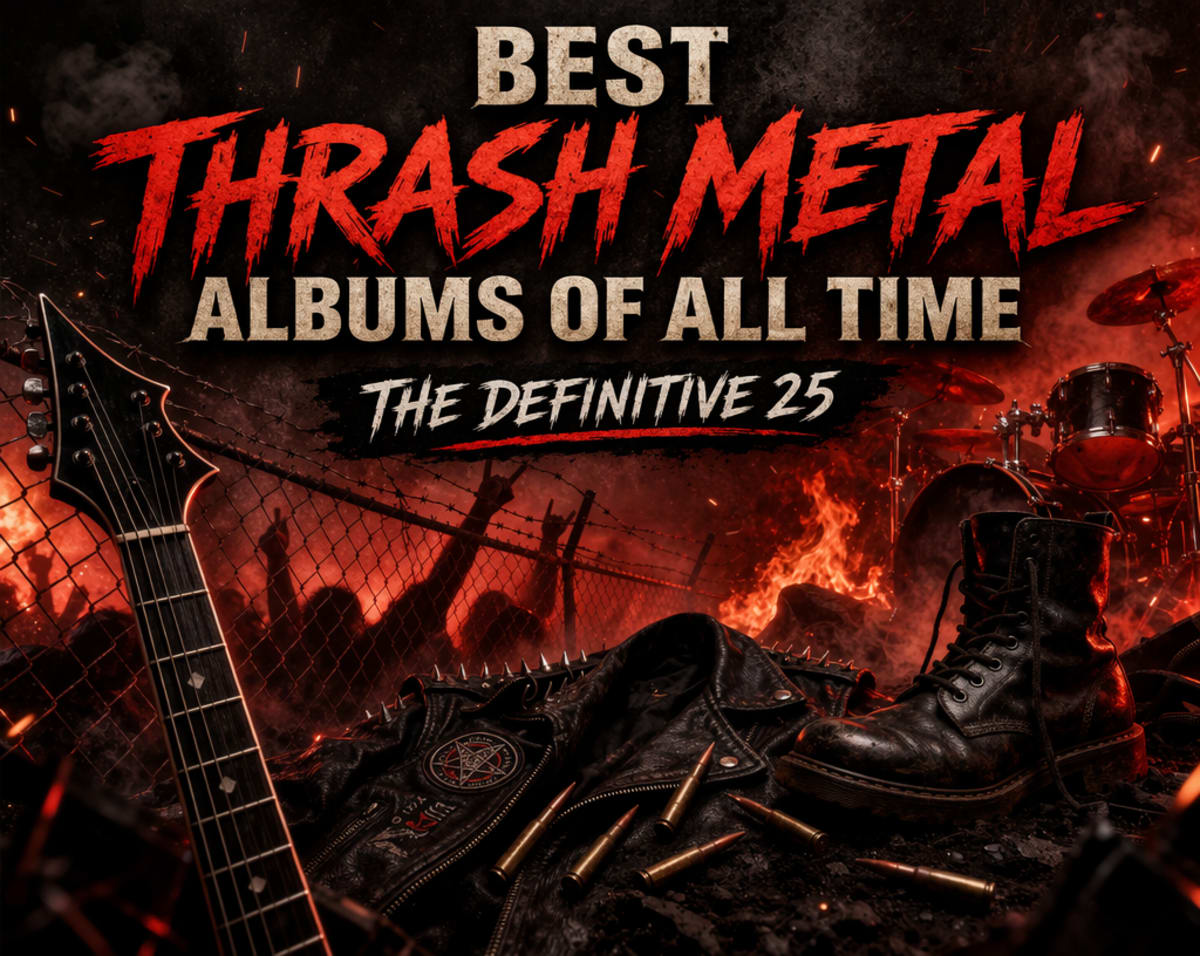
Thrash metal is precision violence. It took punk aggression and heavy metal technique and collapsed the distance between them — fast, dense, hostile to mainstream accessibility. The riff wasn't just a hook; it was a weapon.
The genre's center of gravity formed in the Bay Area in the early 1980s. Metallica, Exodus, Testament, Vio-lence — bands that fed off each other and collectively defined a template metal has worked from ever since. By 1986 the movement had gone global: Germany's Kreator, Sodom, and Destruction brought a rawer strain. Brazil gave the world Sepultura.
The golden window ran 1983 to 1991. First Wave built the vocabulary. The Golden Age pushed into greater complexity and full articulation of what thrash could accomplish. Then the 90s arrived, grunge flattened the market, and the scene fractured. The records survived.
Here are the 25 best thrash metal albums ever made. No hedging. No nostalgia grading. Just the music.
#1 — Reign in Blood — Slayer (1986)
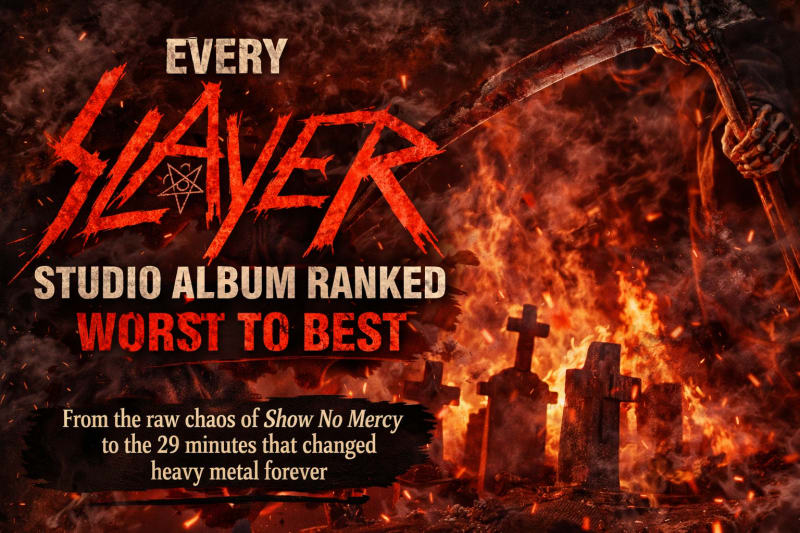
The argument ends here. Twenty-nine minutes, ten tracks, not a single moment of self-indulgence. The opening riff of "Angel of Death" announced immediately that this record was operating outside normal parameters — something that could not be placed next to its contemporaries without making them sound incomplete. Rick Rubin stripped Slayer to pure structural aggression and what emerged was not just a great record but a blueprint: the document that defined how extreme metal could be made, how much could be said with how little. Every band that followed owes a debt to this record. Most of them are still paying.
#2 — Master of Puppets — Metallica (1986)
The album that proved thrash could be compositionally ambitious without sacrificing the attack. Eight tracks, none under five minutes, and not a second wasted. "Battery" opens the record like a controlled detonation. The title track is eight and a half minutes of structural precision that somehow never loses its momentum. James Hetfield and Lars Ulrich were writing at a level that outpaced virtually every contemporary, and Cliff Burton's bass performance throughout is a masterclass in using the instrument as a lead voice. The last great Metallica album and one of the ten best metal records ever made.
#3 — Rust in Peace — Megadeth (1990)
Dave Mustaine assembled the definitive Megadeth lineup — Marty Friedman and Nick Menza completing the picture — and then wrote the most technically demanding and musically cohesive record of his career. "Holy Wars... The Punishment Due" opens the album in a state of barely controlled chaos and everything that follows matches its intensity. "Tornado of Souls" is peak Megadeth: intricate, aggressive, and driven by a Friedman solo in the outro that belongs in any serious conversation about the best guitar performances on record. Rust in Peace is the rare case where the technical ambition and the raw fury stayed in perfect balance.
#4 — Among the Living — Anthrax (1987)
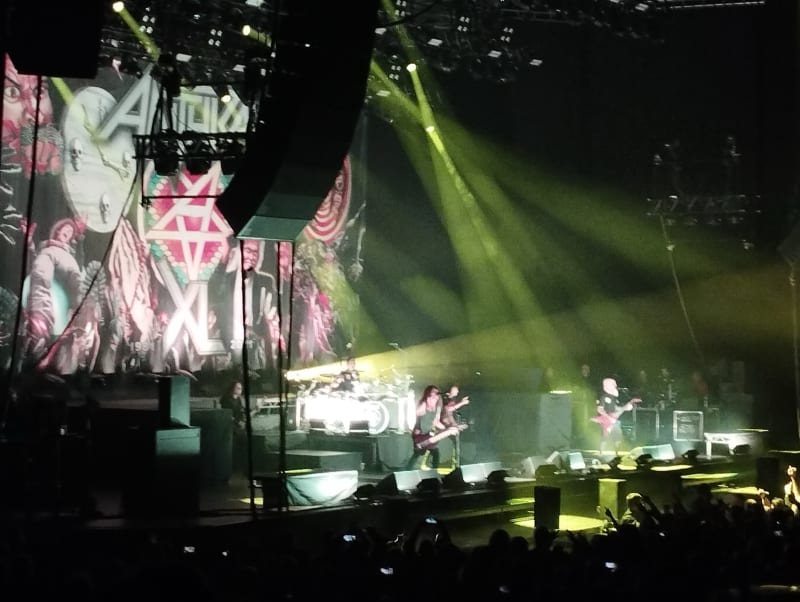
Anthrax's fullest statement and the record that expanded what thrash's vocabulary could address. The Stephen King references, the Judge Dredd comic influence, the crossover hip-hop energy — Among the Living was a band thinking bigger while playing harder. "I Am the Law" and the title track are essential. Scott Ian's rhythm guitar is a lesson in groove-driven thrash that the Bay Area bands never quite found. Joey Belladonna's vocals gave Anthrax a melodic dimension that set them apart from their peers without softening the attack. This is where they peaked.
#5 — Bonded by Blood — Exodus (1985)
Exodus handed Gary Holt and Paul Baloff the mic in 1985 and the result is one of the most ferocious debut albums in thrash history. Recorded fast, mixed raw, built to physically assault — Bonded by Blood is the document of the Bay Area scene at its most feral and uncompromising. Kirk Hammett learned to play metal in this band. He left for Metallica and Exodus didn't skip a beat. "A Lesson in Violence" and "Strike of the Beast" are as good as anything the Big Four were making simultaneously.
#6 — Pleasure to Kill — Kreator (1986)
Germany's Teutonic thrash scene gets its first entry here — and Pleasure to Kill earns its placement at the top. Mille Petrozza leading a then-teenage Kreator through 35 minutes of deranged, hyper-violent thrash that pushed the genre's intensity to a point that shocked even seasoned listeners at the time. The riffing is relentless, the production is appropriately ugly, and the sheer conviction of the performance sold ideas that should've sounded ridiculous. Germany proved in 1986 that Bay Area didn't have a monopoly on extreme.
#7 — Peace Sells... But Who's Buying? — Megadeth (1986)
Dave Mustaine's political fury sharpened into the best record Megadeth had made to that point. The title track is one of the most recognizable bass intros in metal history and one of the most effective thrash songs ever written. "Devil's Island," "Wake Up Dead," "The Conjuring" — this is Megadeth when they were genuinely dangerous, before precision became the primary value and the anger got diluted. The production has aged better than most of its era. An essential document.
#8 — Darkness Descends — Dark Angel (1986)
Dark Angel got criminally overlooked during the genre's peak years and their absence from most mainstream rankings is a genuine injustice. Darkness Descends is thrash played at its absolute structural limit — Gene Hoglan's drumming alone makes this a required listen, laying down a performance that shouldn't have been physically possible at that tempo. The riff density is staggering. The record doesn't chase commercial appeal for a single second. If you only know the Big Four, Darkness Descends is the correction.
#9 — The Legacy — Testament (1987)
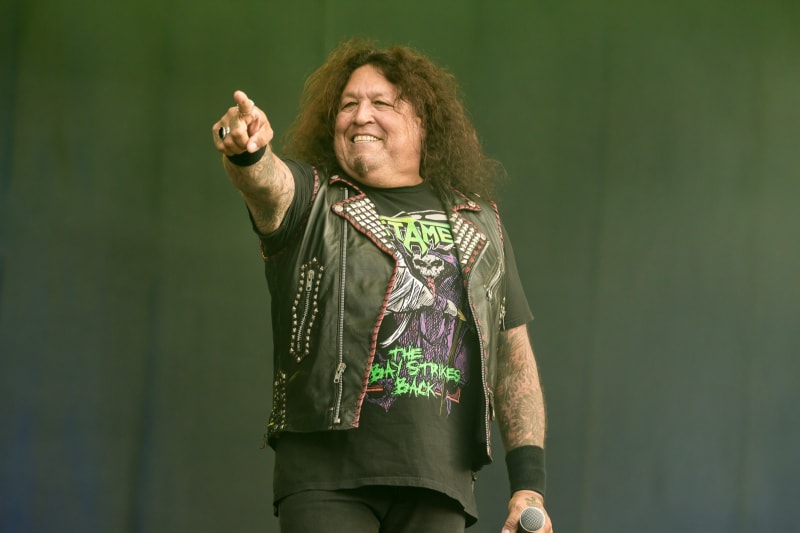
Bay Area thrash's most overlooked gem from its debut year. Chuck Billy hadn't joined yet — Steve Souza handles vocal duties — but the band's compositional sophistication was already in place. Alex Skolnick's guitar work is technically precise and melodically interesting in a way that most thrash bands avoided. "Over the Wall" and "Into the Pit" defined what Testament was and remain among the best tracks the genre produced in the 80s. The record launched a run of first-class albums that deserved a bigger commercial audience than they got.
#10 — Persecution Mania — Sodom (1987)
Tom Angelripper's Sodom arrived with the roughest edges of the Teutonic thrash movement and Persecution Mania is where those edges became compositional strengths rather than production limitations. Aggressive in a way that felt less like ambition and more like necessity — Sodom thrashed because that's what the material demanded. "Enchanted Land," "Persecution Mania," "Nuclear Winter" — a record built for the kind of listener who finds Reign in Blood a little polished. Genuinely vicious and absolutely essential.
#11 — Spreading the Disease — Anthrax (1985)
The Anthrax record that preceded Among the Living and established the formula. Joey Belladonna's arrival changed the band's trajectory completely — his melodic instincts provided contrast that made the aggressive moments hit harder. "Madhouse" is still one of the most recognizable thrash tracks in existence. Spreading the Disease is where the New York school of thrash found its voice: equal parts heavy and accessible, technically demanding and immediately memorable.
#12 — Kill 'Em All — Metallica (1983)
The first proper thrash album. The record that defined the starting point for everything that followed. Kill 'Em All is rawer, less compositionally ambitious, and more aggressive-for-aggression's-sake than what Metallica would make next — and that directness is precisely what makes it important. "The Four Horsemen," "Whiplash," "Seek & Destroy" — a teenage band from San Francisco/Los Angeles writing the grammar of a new genre. The production is rough and that's fine. It sounds like 1983 because it is 1983.
#13 — Beneath the Remains — Sepultura (1989)
Brazil sends its answer. Andreas Kisser joins the lineup and Beneath the Remains is the moment Sepultura became a world-class band rather than a promising regional act. Scott Burns at Morrisound gave the record the production weight it needed. The riffing balances Bay Area precision with a more primitive, physically aggressive quality that made Sepultura sound distinct rather than derivative. Essential for understanding how globally the genre had spread by decade's end.
#14 — South of Heaven — Slayer (1988)
Slayer slowing down felt like apostasy in 1988. In retrospect it's a masterclass in restraint producing heavier results than speed ever could. The title track alone — its pace, its atmosphere, the deliberate patience of it — demonstrates a compositional sophistication that most of their contemporaries weren't reaching for. South of Heaven is the most misunderstood major thrash album of the 80s and it belongs this high on the list.
#15 — Hell Awaits — Slayer (1985)
The Slayer record that proved Show No Mercy wasn't a fluke and set the stage for Reign in Blood. Longer songs, darker textures, genuine compositional ambition — Hell Awaits is Hanneman and King finding the outer limits of what the thrash vocabulary could contain. If Reign in Blood hadn't followed eighteen months later, this would be the definitive Slayer statement.
#16 — Show No Mercy — Slayer (1983)
Two 21-year-olds writing a record that had no sonic precedent and sounded like it knew exactly what it was doing anyway. Show No Mercy is proto-thrash in the truest sense: genre lines barely existed yet, and Slayer was drawing them in real time. The production is thin and the budget was nonexistent and none of that matters because the riffs are untouchable.
#17 — Infernal Overkill — Destruction (1985)
The third pillar of the Teutonic thrash triumvirate, and Infernal Overkill is Destruction in their most combustible form. Schmier's vocals are an acquired taste — shrill, abrasive, deliberately unpolished — and the production matches that aesthetic perfectly. The aggression is genuine rather than performed. "Bestial Invasion" and "Thrash Attack" are exactly what their titles promise. Germany's underground scene produced its own rulebook and Destruction wrote the first chapter.
#18 — Practice What You Preach — Testament (1989)
The album that got me into thrash. Testament completing a three-album run of increasingly polished and accessible thrash without surrendering the core. Practice What You Preach was their closest brush with mainstream success — brighter production, more radio-ready sonics — but the songwriting held. Alex Skolnick's guitar work remained the distinguishing quality. This record proved that thrash didn't have to be inaccessible to be legitimate. It’s getting a 2026 remaster that it absolutely deserves.
#19 — Eternal Nightmare — Vio-lence (1988)
Bay Area thrash's most underrated album. Sean Killian's vocals are unhinged in a way that suited the material perfectly, and the guitar work — Phil Demmel and Robb Flynn, who would later found Machine Head — is among the most technically precise in the late 80s scene. Eternal Nightmare never found commercial traction because Vio-lence were too weird and too intense for the radio-adjacent market. That weirdness is exactly what makes it hold up.
#20 — The New Order — Testament (1988)
Testament's second album tightening everything that The Legacy established. Chuck Billy fully settled into the vocalist role and the band's compositional range expanded accordingly. "Disciples of the Watch" and "The New Order" are among the most complete tracks Testament ever recorded. The production is cleaner than the debut without losing the aggression — a difficult balance that most bands in this scene never successfully managed.
#21 — Fabulous Disaster — Exodus (1989)
A personal favorite. Exodus in the final phase of their original run — Zetro Souza replacing Paul Baloff, the sound polished without being softened. Fabulous Disaster is thrash made for the headbanger who also wants a hook: "Open Season," "The Toxic Waltz," their ferocious cover of "Low Rider." A band that understood accessibility didn't have to mean surrender. Not as feral as Bonded by Blood, but tighter, and the best argument for why Exodus always belonged in the Big Four conversation.
#22 — Seasons in the Abyss — Slayer (1990)
"War Ensemble" opens Seasons in the Abyss and immediately communicates that Slayer could write a thrash song with actual groove — momentum built from precision rather than pure aggression. The title track is a legitimate epic, fully atmospheric and structurally unlike anything else in the catalog. This is Slayer at their most compositionally diverse, which is also its own kind of achievement.
#23 — Act III — Death Angel (1990)
Death Angel were teenagers when they started making records and by Act III they'd grown into one of the most dynamic acts in the Bay Area. They're touring on the album's legacy right now and it still holds up live. This is the album where the band stopped being compared to their peers and started being measured on their own terms — more groove, more range, more compositional ambition than their earlier work. "Seemingly Endless Time" and "A Room with a View" showed a band comfortable stretching beyond pure thrash without abandoning the foundation. The tour bus crash in Arizona that nearly killed 18-year-old drummer Andy Galeon derailed them right as Act III was breaking the band into a wider audience. They disbanded in 1991, and what should have been a career-defining run became one of thrash's greatest what-ifs.
#24 — Time Does Not Heal — Dark Angel (1991)
Dark Angel's final album and their most technically accomplished. Gene Hoglan's drumming by 1991 had become genuinely inhuman — his performance here remains one of the most staggering in thrash history. The songwriting is denser than Darkness Descends, which works in its favor and occasionally against it. The band broke up shortly after release; Time Does Not Heal served as both peak and farewell.
#25 — Victims of Deception — Heathen (1991)
Bay Area's best kept secret. Heathen never cracked the commercial tier occupied by the Big Four, but Victims of Deception is technically and compositionally superior to a substantial portion of what did. The guitar interplay between Lee Altus and Doug Piercy is intricate without being indulgent. Kragen Lum's precise vocals gave the record a melodic dimension most thrash avoided. Essential for anyone who thinks they've exhausted the Bay Area catalog.
Build Your Collection
These records belong in your library in physical format. Start with the blueprint:
Shop thrash metal albums on Amazon
Metallica fans: Strüng makes a Master of Puppets bracelet — code Metal Mantra for 20% off.
Slayer fans: Strüng makes a Raining Blood bracelet — code Metal Mantra for 20% off.
Megadeth fans: Strüng makes a Symphony of Destruction bracelet — code Metal Mantra for 20% off.