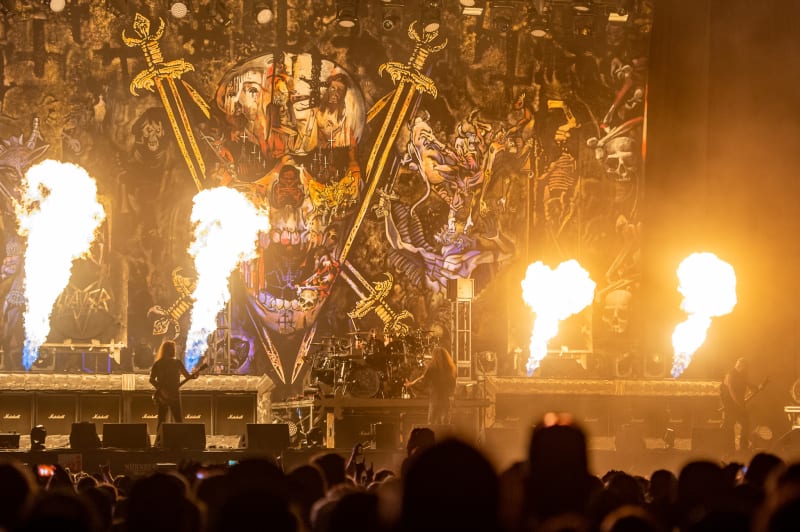
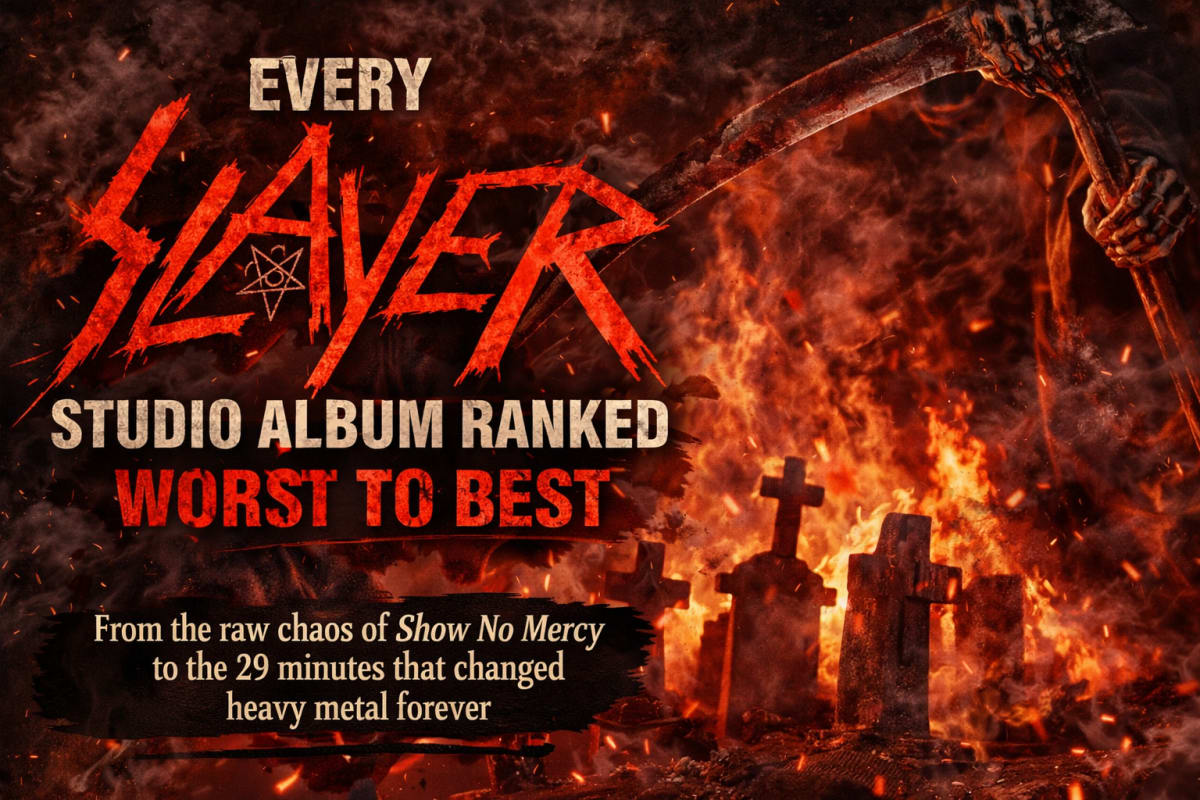
Slayer existed for 37 years. They released 12 studio albums. They played their final show in November 2019 at the Forum in Los Angeles and walked off the stage as one of the most important bands in the history of heavy music. Ranking their discography isn't an exercise in nostalgia — it's a structural audit of what they built, what held up, and where they lost the thread.
The timeline matters here. Jeff Hanneman — co-founder, primary songwriter, the architect of the riff vocabulary that made Slayer Slayer — contracted necrotizing fasciitis from a spider bite in early 2011. He underwent years of surgeries and rehabilitation, returning briefly before his death from liver failure on May 2, 2013. He was 49. He wrote "Raining Blood." He wrote "Angel of Death." He wrote "South of Heaven" and "Hell Awaits" and "Seasons in the Abyss." He is the single most important creative force in this band's catalog, and his absence is the line that divides Slayer's discography into two fundamentally different eras — the records that matter most and the ones that exist in their shadow. The records he's on carry a different weight knowing what was lost. The ones made after his death carry a different kind of weight entirely.
Kerry King kept the band going after Hanneman's passing, and the 2019 farewell tour gave Slayer a proper sendoff — a two-year global run that ended exactly where it should have, in Los Angeles, the city where it all started. But Kerry King's Slayer and Jeff Hanneman's Slayer are different entities, and this ranking reflects that reality.
This ranking doesn't grade on a curve for legacy. It grades on the music. Here's every Slayer studio album from worst to best.
#12 — Repentless (2015)
The first Slayer album without Jeff Hanneman on any level — the riffs, the writing, the spirit. Kerry King handled the bulk of the songwriting and you can feel the difference immediately: technically competent, occasionally aggressive, spiritually empty. Repentless sounds like a band completing a contractual obligation rather than making a statement. There are moments — the title track has some menace, and Gary Holt from Exodus contributed guitar work that elevates a handful of tracks — but this record will never stand next to anything in the top half of this list. Paul Bostaph's drumming is fine. Tom Araya's vocals are fine. Everything is fine, and fine is the least Slayer thing imaginable. It exists. That's about all you can say.
#11 — Undisputed Attitude (1996)
A covers album that got filed into the studio discography, which is the only reason it's on this list. Slayer ripping through hardcore and punk tracks — DRI, Minor Threat, TSOL, Verbal Abuse — is a fun 30 minutes that tells you more about where Hanneman and King's heads were at than any press interview from the era. It confirms that Slayer's roots ran through California hardcore as much as NWOBHM. But it's not a Slayer album — it's a palate cleanser released between Divine Intervention and Diabolus in Musica that functions as an interesting footnote at best. The two original tracks ("Gemini" and "I Hate You") at the end are decent. File it where it belongs: historically interesting, creatively limited, not essential.
#10 — Diabolus in Musica (1998)
Late-90s Slayer trying to sound like late-90s everything else — which is to say, nu-metal-adjacent, down-tuned to the point of stupidity, stripped of the precision that made their best work dangerous. "Stain of Mind" has a groove that belongs in a different band's catalog entirely. Diabolus wasn't irredeemable — "Perversions of Pain" and "Overt Enemy" have some heat — but it's the most out-of-character record in their catalog. Slayer does not do trends. This was the one time they tried.
#9 — World Painted Blood (2009)
Competent. That's the word. Hanneman and King delivering a late-career Slayer record that sounds like Slayer without ever threatening to be great. The production is clean in a bad way — antiseptic where it should be savage. There are riffs here that would've been terrifying in 1987. In 2009 they just sound processed. "Unit 731" is worth your time. The rest is genre exercise. If you need your Slayer fix and you've already played everything above it on this list, World Painted Blood will do the job.
#8 — Christ Illusion (2006)
Dave Lombardo returns after six years away and the difference is immediately audible — Christ Illusion breathes in a way that God Hates Us All didn't. The album is more muscular, more dynamic, and occasionally genuinely great. "Catalyst" and "Flesh Storm" are strong. But the record is inconsistent in a way that keeps it out of the top tier, and the production choices blunt what could've been the best late-career Slayer album. Lombardo's presence elevates everything it touches; the material itself is uneven. A near-miss that still outperforms most of what came after.
#7 — Divine Intervention (1994)
Nobody talks about Divine Intervention and that's a mistake. Released into a landscape where grunge had flattened the metal market and metal radio had collapsed, it came and went without the cultural impact it deserved. But listen to it now: "Killing Fields," "Circle of Beliefs," "Sex. Murder. Art." — this is a band in transition, leaning harder and darker than the commercial moves of Seasons in the Abyss suggested they would. Hanneman's writing is as sharp as it had been in years. Paul Bostaph stepped in for Lombardo and delivered a performance that proves the drum chair was in capable hands. The production is dry in a way that actually suits the material — less polished than its predecessor, more confrontational. An underrated record that deserves a serious second look from anyone who dismissed it as a casualty of the alt-rock era.
#6 — God Hates Us All (2001)
God Hates Us All dropped on September 11, 2001. The title became either the most tone-deaf scheduling in music history or the most eerily prescient, depending on your worldview. The record itself is dark, grinding, and more interesting than the critical response acknowledged at the time — critics were busy with other things that week. Lombardo was gone again, replaced by Paul Bostaph, but the drum performance holds. "Bloodline" charted. "New Faith" is a sledgehammer. This record wore the nu-metal era's sonic fingerprints without fully becoming it, which is more than Diabolus managed.
#5 — Seasons in the Abyss (1990)
The bridge record. Seasons in the Abyss sits between the ferocity of the classic era and the more structured, commercially aware approach that followed. It works because Slayer didn't fully commit to either direction — they stayed vicious while adding texture. "War Ensemble" alone justifies the placement: one of the ten best Slayer songs ever written, a machine-precise assault that somehow also has a groove. The title track is a legitimate epic. Seasons is the last record where Slayer felt like they were expanding their palette rather than managing their legacy.
#4 — South of Heaven (1988)
The slow Slayer album. In 1988, after Reign in Blood, this felt like a betrayal to some people. They were wrong. South of Heaven is Slayer demonstrating that they could write songs — not just riffs, not just velocity — but actual songs with dynamics and restraint. "Mandatory Suicide," "Behind the Crooked Cross," "Spill the Blood" — these are compositions. The title track is paced at half the speed of anything on Reign and it hits harder because of it. Thirty-eight years later, South of Heaven reads as the most mature record in the catalog. Misunderstood at the time. Essential in retrospect.
#3 — Show No Mercy (1983)
Raw, feral, recorded for next to nothing on the Metal Blade label, and nobody was doing what Slayer was doing in 1983. Not at this speed, not with this aggression, not with this level of intentional darkness. Show No Mercy is proto-thrash with a heavy metal skeleton and a black metal soul — before any of those genre lines had been drawn, before the scene had a name, before the venues were big enough to matter. "Evil Has No Boundaries," "The Antichrist," "Die by the Sword," "Black Magic" — these tracks defined what the next decade of extreme metal would reach for. Hanneman and King were 21 years old, Tom Araya was 22, and Dave Lombardo was barely out of high school. They wrote the template before the genre existed and handed it to every band that followed. Almost none of them came close.
#2 — Hell Awaits (1985)
The record that proved Show No Mercy wasn't an accident. Hell Awaits is where Slayer showed they could build structures, not just attack — longer songs, darker atmospheres, the kind of compositional ambition that the NWOBHM influence brought and thrash's speed stripped out of almost everyone else. The title track opens with a reversed spoken passage and builds into something genuinely sinister. "Praise of Death" and "At Dawn They Sleep" are exercises in controlled savagery. This is the record where Hanneman's guitar voice locked in as something fully distinct. If Reign in Blood hadn't come next, Hell Awaits would be the peak.
#1 — Reign in Blood (1986)
Twenty-nine minutes. Ten tracks. No filler. Opener "Angel of Death" is one of the most violent and precise things anyone has ever committed to tape — a first riff that immediately established where this record existed relative to everything else. Rick Rubin stripped Slayer to the studs and what remained was something approaching perfection: pure velocity, surgical aggression, a complete absence of self-indulgence. "Raining Blood" closes the record with one of the most iconic intros in metal history and then delivers on every second of what it promises.
Reign in Blood didn't just change heavy metal — it set a ceiling that the genre spent the next four decades failing to touch. If you own one Slayer record, it's this one. If you own all twelve, you already know this is the one you come back to.
Jeff Hanneman wrote the majority of this album. He wrote "Angel of Death." He wrote "Raining Blood." He wrote it when he was 22 years old and he never made anything more perfect, because nothing more perfect was possible. The band he co-founded played their final show in November 2019 — 33 years after this record was released — and the capacity crowd at the Forum sang every word of every song. The legacy Hanneman built on these ten tracks has outlasted his death, outlasted the farewell tour, and will outlast every argument about what thrash metal was capable of. This is the answer to that argument. It always was.
For more on the bands that shaped thrash, see our Best Thrash Metal Albums of All Time — and check the Metal Mantra reviews archive for current coverage.
Own the classic in whatever format suits you: Slayer — Reign in Blood on Amazon
Slayer fans: Strüng makes a Raining Blood bracelet — use code Metal Mantra for 20% off.