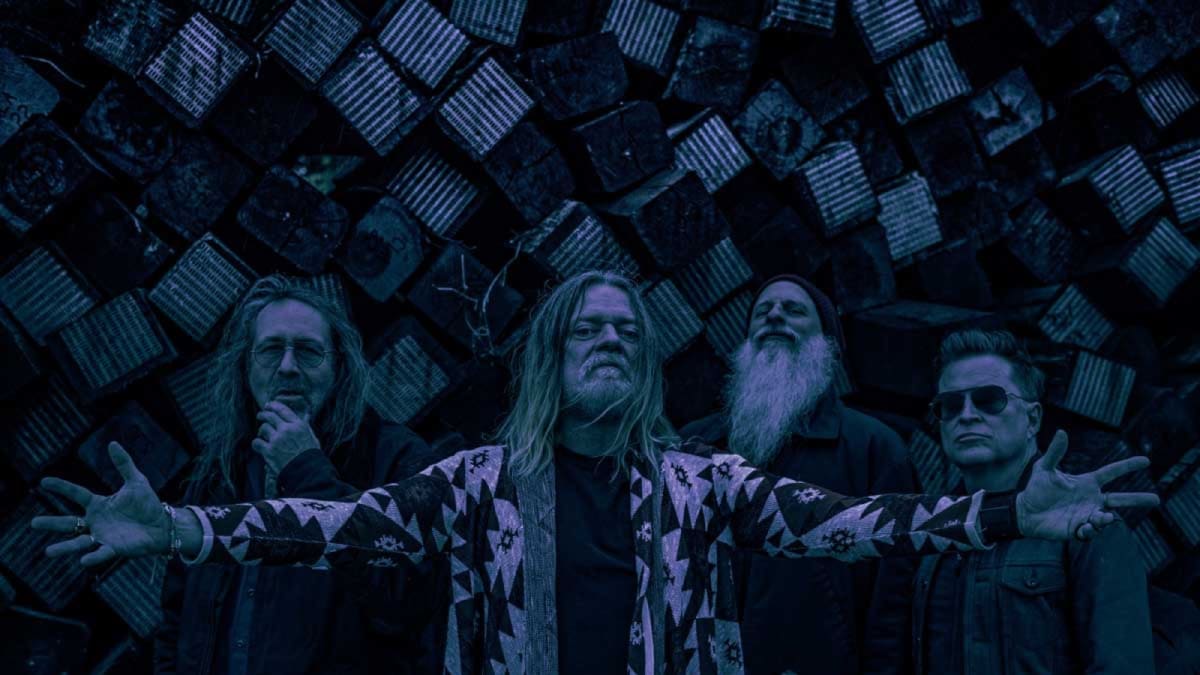
Eight years is a long time. Long enough for a founding member to die. Long enough for another to walk. Long enough for a pandemic to shut down the planet, for two guys from Raleigh to hunker down in Mississippi and start writing without knowing where it was going or what it would become.
What it became was Good God / Baad Man — 14 songs, two discs, and the most complete statement Corrosion of Conformity have made in a very long time.
What This Record Is
This isn't just an album. It's a document of a band reckoning with its own range.
After the death of founding drummer Reed Mullin in January 2020 and the subsequent departure of bassist Mike Dean, Pepper Keenan and Woody Weatherman didn't call it quits. They went back to the source — Discharge, ZZ Top, Motörhead, Neil Young, Black Sabbath — and started writing. What came out was too much for one record, and too different to force into one shape. "As we went on, we had such a crazy plethora of songs, it was almost like two different directions," Keenan explained. "We knew we had to split it into two different albums."
The concept became the title. Good God / Baad Man.
Disc one (Good God) is the fire. Six tracks leaning into the band's punk-rooted, Blind-era aggression — riffs that hit hard, tempos that don't apologize, attitude dialed to maximum. Disc two (Baad Man) is the gravity — eight tracks that swing like the front porch of a Mississippi delta barrelhouse, channeling Grand Funk Railroad, ZZ Top, and Lynyrd Skynyrd into the COC framework. Producer Warren Riker — Grammy-decorated, but with the right instincts here — reportedly described the project as "Dark Side of the Doom." He's not wrong.
The Band on This Record
Stanton Moore returns on drums, his first studio appearance with COC since 2005's In the Arms of God. Moore is an elite player — his New Orleans background brings a looseness and pocket to the grooves that keeps the heavier material from feeling too rigid. For a band missing the irreplaceable Reed Mullin, he's the right person to be holding the sticks.
Bobby "Rock" Landgraf handles bass, pulling from his time with Pepper in Down and his own band Honky. The rhythm section is tight where it needs to be and loose where the song demands it.
The album also features Al Jourgensen of Ministry and Monte Pittman on Gimme Some Moore, the first single. It's the most direct callback to COC's pre-Deliverance hardcore roots — raw, driving, deliberately scrappy, and a smart choice to reintroduce the band after eight years of silence.
Good God (Disc One)
Good God opens with Good God? / Final Dawn, a two-part track that announces intent immediately. The riff is direct and physical. There's no warm-up — this is COC at their most uncompromising, the version of the band that hit No. 29 on Billboard out of nowhere in 1993 with an album built on exactly this kind of controlled fury.
You or Me is the disc's centrepiece — a crushing mid-paced groove that locks into a pocket and refuses to leave. Keenan's vocal delivery on this one is among the best on the record: commanding without grandstanding, menacing without the self-awareness that can kill this kind of performance.
Gimme Some Moore is a direct line back to the Eye for an Eye / Animosity era, complete with Jourgensen's gang vocal contribution and an energy that feels like a band playing faster just because they can. The Handler and Bedouin's Hand maintain the intensity through the disc's middle section, with Run for Your Life closing Good God on a note that leaves nothing unfinished.
The production on this disc has warmth and physicality. Riker didn't sanitize it — the edges are still there.
Baad Man (Disc Two)
The shift in register on Baad Man is real but not jarring. This isn't a COC you haven't heard before — it's one you've caught in glimpses on Deliverance and America's Volume Dealer, now given eight full songs to stretch out.
Baad Man (the track) opens disc two with a slow crawl that immediately communicates the tonal shift. What follows is COC doing what the Allman Brothers and ZZ Top did when they were at their best: making rocking feel effortless. Mandra Sonos has a swinging, almost psychedelic quality. Asleep on the Killing Floor is the record's most southern rock-coded moment — and it earns that comparison rather than merely wearing it as a costume.
Swallowing the Anchor and Brickman are the disc's most memorable songs structurally, built on the kind of melodic instinct COC developed over Deliverance-era material but here applied with less concern for commercial appeal. Forever Amplified closes the record on a note of genuine emotional weight — a song that, in the context of losing Reed Mullin, feels like both a tribute and a continuation.
The Reed Mullin Shadow
It's impossible to engage with this record without thinking about Reed Mullin. Keenan has been direct about it: "With a lot of these songs, we're trying to make Reed Mullin proud." That weight is present throughout, but it doesn't drag the album into grief-project territory. Good God / Baad Man is, ultimately, a living document — music made by people who decided to keep going rather than stop.
That decision, and what came from it, is the record's strongest argument.
Verdict
Good God / Baad Man is the return COC deserved to make. It doesn't ask for sympathy for what the band went through to get here — it just delivers. Good God is among the most urgent heavy music Keenan and Weatherman have produced since the nineties. Baad Man is looser and more generous, a record about range rather than force.
Together, they account for the full spectrum of what this band is and has always been. For longtime fans, this is the real thing. For anyone who's been sleeping on COC, the double-album format gives you every possible on-ramp.
Eight years. Worth every day of it.
8/10
Good God / Baad Man is out April 3 via Nuclear Blast Records. Stream and order at Amazon. For concert dates on the current North American run, check the Metal Mantra tours page.
Previously on Metal Mantra: Corrosion of Conformity July 2026 North American Tour Dates — Whores. and Crobot in support.