People mix these two up constantly. Ask someone who doesn't listen to metal to name a heavy band, and they'll say something like "death metal or whatever" — using it as a catch-all for anything with blast beats and screaming. Ask someone who listens to a little metal, and they might lump Cannibal Corpse and Darkthrone together like they're cousins.
They're not cousins. They're from different countries, different philosophies, and they're doing entirely different things to your skull when you put them on.
Here's the actual breakdown.
Where They Come From
Death metal was born in Florida in the mid-1980s. Chuck Schuldiner's Death is widely credited as the foundational act — Scream Bloody Gore (1987) set the blueprint. Around the same time, bands like Possessed, Obituary, Morbid Angel, and Cannibal Corpse were developing the sound out of Tampa and the surrounding scene. The New York scene gave us Suffocation and Immolation. Death metal is distinctly American in its roots, though Sweden contributed its own flavor via Entombed and Dismember — the HM-2 guitar tone that still defines Swedish death metal.
Black metal traces back to the UK and Scandinavia. Venom coined the term "black metal" on their 1982 album of the same name, but the second wave — the defining movement — came out of Norway in the early 1990s. Darkthrone, Mayhem, Burzum, Immortal, Emperor — these bands built the genre's aesthetic, philosophy, and sonic identity. The Norwegian scene is also infamous for the church burnings and murders that surrounded it in the early '90s, which both stained and mythologized the genre permanently.
The Sonic Differences
This is where the genres diverge most clearly.
Death metal is surgical. It emphasizes:
- Heavily down-tuned guitars
- Thick, grinding riff structures (palm muting, tremolo picking)
- Blast beats executed with precision
- Guttural, low-register vocals — deep growls and grunts
- Production that's often dense and full, with audible bass
- Technical complexity — especially in sub-branches like brutal death and technical death
The goal of death metal is physical. It's designed to hit you in the chest. The rhythm section is the engine. Bands like Nile layer in ancient Egyptian themes and flurries of technical guitar work; Suffocation turned polyrhythmic breakdowns into an art form; Obituary keeps it slow and crushing. But all of it operates in the same physical register — it wants to affect your body.
Black metal is atmospheric. It emphasizes:
- Thin, trebly guitar tone — deliberately harsh and abrasive
- Raw, lo-fi production (especially in the second wave and beyond)
- High-pitched shrieking vocals
- Long, repetitive passages designed for trance-like immersion
- Cold, wintery, nihilistic or anti-Christian themes
- Blast beats used for texture as much as brutality
Where death metal punches, black metal envelops. A Darkthrone record sounds like standing outside in a blizzard. A Dimmu Borgir record sounds like a movie score for the end of a religion. Even Behemoth — who fuse both genres to devastating effect — still carries that sweeping ceremonial quality in their songwriting that death metal rarely chases.
Aesthetics and Philosophy
The visual and ideological differences are just as stark.
Death metal imagery is corporeal — bodies, gore, surgical horror, violent death. Album covers by Cannibal Corpse are almost parody in their extremity, but they're also completely sincere expressions of the genre's fixation on physical annihilation. The aesthetic is direct, crude, and intentionally repulsive to outsiders.
Black metal aesthetics are occult and elemental — corpse paint, forests, castles, Satanic symbolism, medieval imagery, and cold darkness. It wants to be ancient. It wants to feel like something pre-Christian and untameable. The philosophy is nihilistic, misanthropic, or spiritual in a decidedly anti-humanist direction.
Crucially: black metal takes itself very seriously. Death metal has a dark sense of humor embedded in the genre — Cannibal Corpse's song titles are absurdist at some level, and the scene has always had room to laugh at itself. Black metal has very little tolerance for self-mockery.
Where They Overlap
The clearest overlap is Behemoth. Nergal explicitly describes his band as blackened death metal — they carry the ceremonial Satanic sweep of black metal fused with the heaviness and technical brutality of death metal. It works because they're genuinely excellent at both.
Deicide sits close to the overlap zone — explicitly anti-Christian in the way black metal is, but the musical execution is pure American death metal aggression.
Immolation are technically death metal but their riffing carries a dissonant, spiraling quality that gives them a darker, more atmospheric feel than most of their Tampa peers.
There are also regional scenes — like Melodic Death Metal (In Flames, Arch Enemy, At the Gates) that fused Gothenburg melodicism with death metal aggression — and bands in the War Metal or Bestial tradition that push black metal closer to death metal's physical intensity. But these are sub-branches. The trunk of the tree is still the Florida death metal scene on one side and the Norwegian black metal scene on the other.
Which Is Which: A Quick Reference
If you're listening to death metal:
- Growled, guttural vocals
- Thick guitar tone
- Strong rhythm section, audible bass
- Cover art involving bodies or gore
- Bands: Cannibal Corpse, Morbid Angel, Obituary, Immolation, Suffocation, Possessed, Deicide, Nile
If you're listening to black metal:
- High-pitched shrieking vocals
- Thin, trebly, harsh guitar tone
- Raw or atmospheric production
- Cover art involving forests, ruins, occult imagery, corpse paint
- Bands: Darkthrone, Emperor, Satyricon, Behemoth (blackened death), Dimmu Borgir, Cradle of Filth, Watain
The Production Divide
One thing that's immediately obvious once you understand the split: these genres have completely opposite philosophies about how a record should sound.
Death metal, particularly from the Florida and New York scenes, chases fidelity. Scott Burns at Morrisound Recording in Tampa produced dozens of foundational death metal records — Cannibal Corpse, Obituary, Morbid Angel, Sepultura — and the "Tampa sound" is crisp, thick, defined. You can hear every drum hit. The guitars cut but they also fill. Death metal wants you to hear the precision.
Black metal, especially in its second wave, treated lo-fi production as ideology. Darkthrone's Transilvanian Hunger sounds like it was recorded in a blizzard — intentionally. Burzum's early records are deliberately raw. The idea was that polished production was a compromise, a concession to commercialism and comfort. The ugliness of the recording was part of the message: this music doesn't want you comfortable.
When Dimmu Borgir went full orchestral production with Puritanical Euphoric Misanthropia (2001) and later records, they were criticized by parts of the black metal scene for crossing too far into accessibility. That tension — rawness as authenticity vs. production quality as craft — remains a live debate in black metal circles to this day. Death metal doesn't have that debate. Better production is always better.
The Live Show Difference
Even the live experience is different.
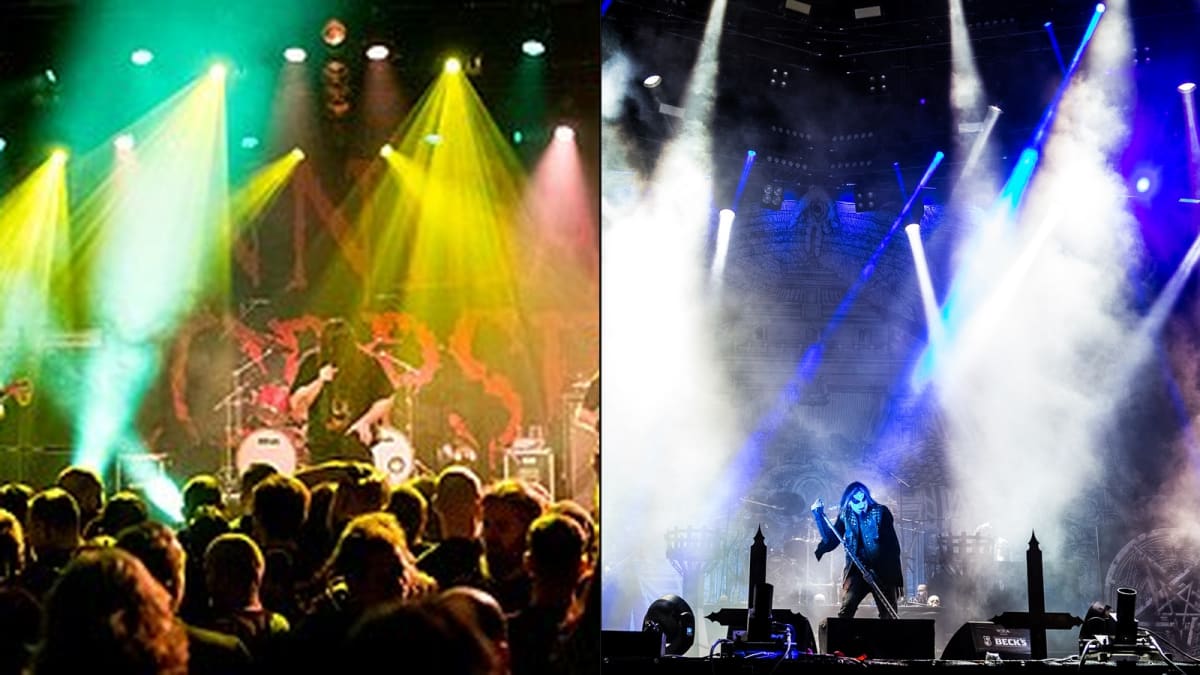
Death metal shows are loud, physical, and tight. Crowds move. Circle pits, walls of death, crowd surfers. Bands like Cannibal Corpse and Suffocation are formidably tight live — the brutality of the record has to translate to the stage in real-time. The production is high. It's a communal athletic experience.
Black metal live shows — particularly for the more kvlt end of the spectrum — have historically been theatrical. Corpse paint, candles, fog, robes. Watain is famous for raw animal blood onstage. Dimmu Borgir on their bigger tours added orchestral elements. Emperor's reunion shows were events. The experience has a ritual quality — less mosh pit, more ceremony.
That said, this distinction is less absolute than it used to be. The extreme metal touring world has mixed these audiences significantly over the past decade. Look at the Deicide, Rotting Christ, and Immolation US tour — that's death metal headliners and Greek extreme metal together. The audiences overlap. They're the same people at this point.
Why It Matters
Knowing the difference matters because these genres are doing fundamentally different things. If you show up at a Suffocation show expecting the atmospheric drift of Emperor, you're going to be confused and headless. If you approach Darkthrone looking for the tight, surgical groove of Obituary, you'll miss everything the record is actually offering.
They share extreme metal's general rejection of mainstream sensibility. But that's where the family resemblance ends.
If you're new to extreme metal and want a primer on the death side, start with Deicide, Rotting Christ, and Immolation's current US tour — it puts three formative acts on the same bill. For black metal, Dimmu Borgir's Grand Serpent Rising is as good a contemporary entry point as any: orchestral, bombastic, and completely serious about what it's doing.
Both genres have earned their place. Both are built to last. They just want different things from you.
New to extreme metal and not sure where to start? Both genres are well-represented on vinyl and CD — browse death metal essentials on Amazon or black metal essentials on Amazon to build your collection.
For more extreme metal coverage, visit Metal Mantra's Metal News archive and the Reviews section.