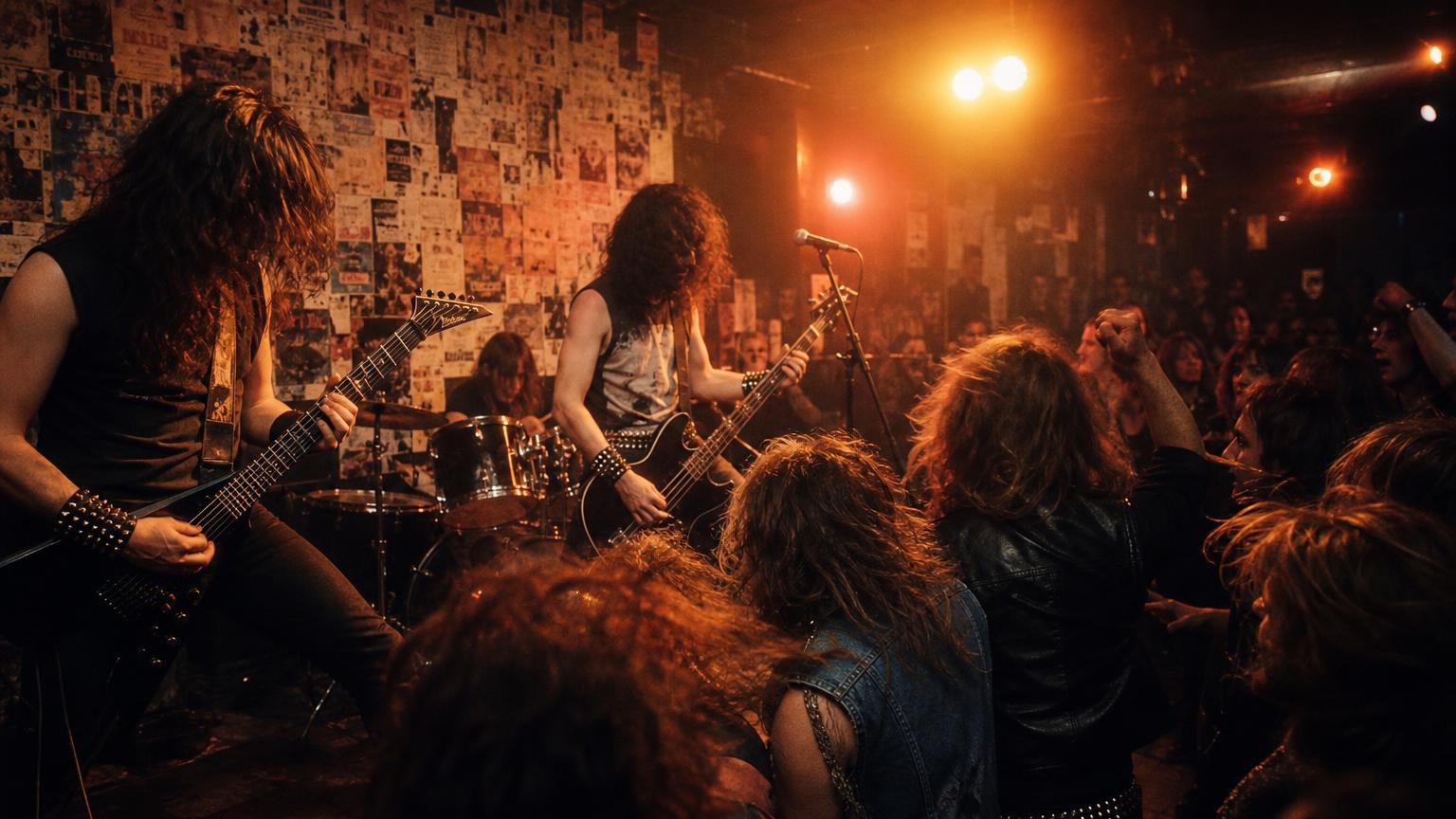
Bay Area thrash did not need a marketing department. It had flyers, record stores, cheap beer, packed clubs, rehearsal spaces, and bands trying to play faster without losing the riff.
If you want the scene in faces instead of summary, start with Murder in the Front Row. The Bay Area thrash photo book and the documentary/DVD put the early Bay Area scene on the page and screen: Exodus, Metallica, Testament, Death Angel, Possessed, the fans, and the clubs before nostalgia cleaned up the edges. It is the closest most of us will get to a front-row view of something we were born too late to catch.
The San Francisco Bay Area did not simply produce a few important thrash bands. It gave them a circuit: venues, record stores, fanzines, tape traders, and fans who treated speed and precision like a shared language. Los Angeles had industry gravity. New York had its own concrete bite. The Bay Area had a network that could turn a demo into a reputation.
By the middle of the 1980s, that network had changed heavy metal's center of force. Exodus turned Richmond speed and rehearsal discipline into a benchmark. Metallica arrived from Los Angeles, locked into the Bay Area after Cliff Burton, and turned the underground's tape-trading energy into a world event. Testament, Death Angel, Vio-lence, Forbidden, Heathen, Possessed, and others gave the region depth. It was not one band carrying a flag. It was a cluster of bands pushing the same language in different directions.
The Bay Area Gave Thrash A Different Shape
Thrash gets described as a blend of New Wave of British Heavy Metal melody and punk speed. That is true, but too clean. In the Bay Area, the formula came out less like a genre recipe and more like a local argument.
The riffs had to move. The drums had to keep up. The songs could be rough, but they could not be lazy. The guitar players were pulling from Judas Priest, Motörhead, Diamond Head, Venom, Discharge, hardcore, and whatever else passed through import bins and dubbed cassettes. The result was not just faster heavy metal. It was music built for a crowd that wanted momentum, precision, and release at the same time.
San Francisco and the surrounding cities mattered because the scene had places to gather. Venues like The Stone and Ruthie's Inn became more than clubs. Bands watched each other. Fans carried information from show to show. Demos moved hand to hand. A strong local set could become a rumor, then a cassette, then a reason someone across the country suddenly knew a band from Richmond, Berkeley, Daly City, or Oakland.
Metallica became the biggest name tied to Bay Area thrash, but the region's identity was already bigger than one group.
Exodus Set The Local Temperature
Exodus are the root you cannot write around. Formed in the early 1980s with Tom Hunting, Kirk Hammett, and Gary Holt in the orbit that would become the classic Bay Area thrash story, Exodus had the ugly local spark before the wider world caught up.
Their reputation did not start with glossy packaging. It started with shows, demos, and songs built to make the front row move. When Kirk Hammett left Exodus for Metallica in 1983, it became more than a famous trivia point. It showed how tightly the early Bay Area circuit was wired: the same players, the same crowds, the same pressure to come back louder next time.
Then came Bonded by Blood in 1985. The record was late compared to its legend, but it still landed like a document of something already alive. Paul Baloff's delivery, Holt and Rick Hunolt's guitars, Hunting's push, and the gang-chant violence of the material made Exodus sound less polished than Metallica and more immediate than almost anyone else.
That lineage still matters on the site now. The way Exodus' modern era keeps circling back to old chemistry, Rob Dukes' return, and Gary Holt's long memory is part of why our recent Exodus coverage lands harder when you understand where the band came from. Exodus were never just another veteran thrash act. They were one of the scene's original measuring sticks.
Metallica Turned The Underground Into A Map
Metallica complicate the Bay Area story because they began in Los Angeles. The reason they belong here is simple: the band that changed heavy metal's commercial future found its real early home after the move north.
Metallica's own history puts the shift in plain terms. After the No Life 'Til Leather demo caught fire through tape trading and Bay Area shows went well, the band relocated after convincing Cliff Burton to join. In April 1983, Dave Mustaine was out and Kirk Hammett was in. A few months later, Kill 'Em All gave the underground a record with enough speed, hooks, and attitude to travel well beyond the local circuit that first believed in it.
The Bay Area did not make Metallica famous by itself. It gave them a base where the band's ambition had somewhere to sharpen. The crowd already had Exodus and other locals in its ears, so Metallica had to be fast enough, tight enough, and hungry enough to survive comparison.
By the time Ride the Lightning and Master of Puppets arrived, Metallica had moved past regional identity. But the early Bay Area years still explain the bridge between underground metal and global metal. Tape trading spread more than songs. It spread the idea that a band could be too heavy for the mainstream and still outgrow every limit people tried to place on it.
Testament Brought Discipline To The Second Wave
Testament started as Legacy in Berkeley in 1983, and that detail says plenty. By then, the Bay Area was not waiting for permission. The next wave of bands had a local standard to beat.
Eric Peterson, Alex Skolnick, Greg Christian, Louie Clemente, Steve Souza, and later Chuck Billy all passed through the early Testament story before the band became the version most fans know. By the time Testament got to The Legacy, copying the first wave was not enough. They needed songs that were tighter, vocals with more weight, and lead work that could stand apart from the speed race.
When Testament released The Legacy in 1987, they did not sound late. They sounded ready. Skolnick's leads brought melodic control, while Billy's voice gave the material size without sanding down the aggression.
Testament still carry unusual weight because they were technical without becoming sterile, heavy without losing hooks, and durable enough to keep adding chapters decades later. Our coverage of the Practice What You Preach remaster sits in that same line: Testament as a band built for more than the first explosion.
Death Angel Made Youth Sound Dangerous
Death Angel's origin is still one of the scene's best stories because it should have been too young to work. The Daly City band started with Filipino-American cousins Rob Cavestany, Dennis Pepa, Gus Pepa, and Andy Galeon, then brought in second cousin Mark Osegueda as vocalist in 1984.
The Kill as One demo, produced by Kirk Hammett, helped put them in front of the underground before The Ultra-Violence arrived in 1987. The age detail matters because it was absurd on paper: Galeon was 14, Cavestany and Osegueda were 18, and the band still sounded fully inside the Bay Area attack instead of like kids copying it from a distance.
Death Angel also widened what the Bay Area story looked like. Thrash history can get flattened into the same handful of names, but the band's Filipino-American identity, family ties, and musicianship gave the region another angle. They were not a side note.
Their later history proves the point. Death Angel broke apart after the 1990 tour bus crash, then reunited at Thrash of the Titans in 2001, the benefit for Chuck Billy and Chuck Schuldiner. What could have stayed a what-if became a second life, and Death Angel are still carrying that name forward instead of existing as trivia from the first wave.
Vio-lence, Forbidden, Heathen, And The Deeper Bench
No scene is serious if it only has two or three bands. The Bay Area had a bench.
Vio-lence formed in the mid-1980s and became one of the region's nastier second-wave names, with Eternal Nightmare in 1988 giving the scene another record that refused to smooth itself out. Sean Killian's vocal attack, Phil Demmel's guitar work, Robb Flynn's presence before Machine Head, and the band's frantic writing style gave Vio-lence a personality that still feels separate from the cleaner end of thrash.
Forbidden brought technical bite and vocal range. Heathen leaned into guitar craft and songwriting detail. Possessed pushed the extreme-metal boundary from a different angle, connecting Bay Area heaviness to death metal's early vocabulary. Even when the bands did not all become household names, they made the bar harder to fake.
The second and third rows still matter. That is what separates a real scene from a city with one breakout band.
Tape Trading Was The Scene's Distribution System
Before algorithms, the underground had envelopes.
Tape trading is not a romantic footnote in Bay Area thrash. It was the delivery system. Demos moved through mailboxes, record stores, fanzines, and friends. A kid in another state did not need a label campaign to hear something new. Someone had to dub the tape, write the address, and care enough to send it.
That human friction changed how the music traveled. If a tape made the rounds, it usually meant somebody believed it was worth the effort. Bay Area bands benefited because their records and demos gave people something worth passing along. The speed helped. The riffs helped more.
Why The Scene Still Holds Up
Bay Area thrash holds up because speed was only the first hit. The staying power came from songwriting, rivalry, geography, and community pressure.
Exodus gave the scene its local threat. Metallica showed how far underground momentum could travel. Testament refined the attack. Death Angel brought youth, identity, and technical hunger. Vio-lence and the deeper bench kept anyone from coasting. Venues, stores, fanzines, and traders kept the music moving.
Bay Area thrash was not a museum label. It was a working circuit. Bands learned in public. Fans enforced standards. Demos carried reputations before press campaigns could. Records came later and made the evidence permanent.
If you are rebuilding the sound from scratch, start with the obvious records: Bonded by Blood, Kill 'Em All, Ride the Lightning, The Legacy, The Ultra-Violence, Eternal Nightmare, Forbidden Evil, and Breaking the Silence. Then keep going. Do not treat the Bay Area like a closed golden age. Hear it as a regional scene that taught heavy metal to move with more nerve.
For collectors filling gaps, start with a focused search for Bay Area thrash essentials on Amazon, then work backward through the records that still sound like someone had something to prove.