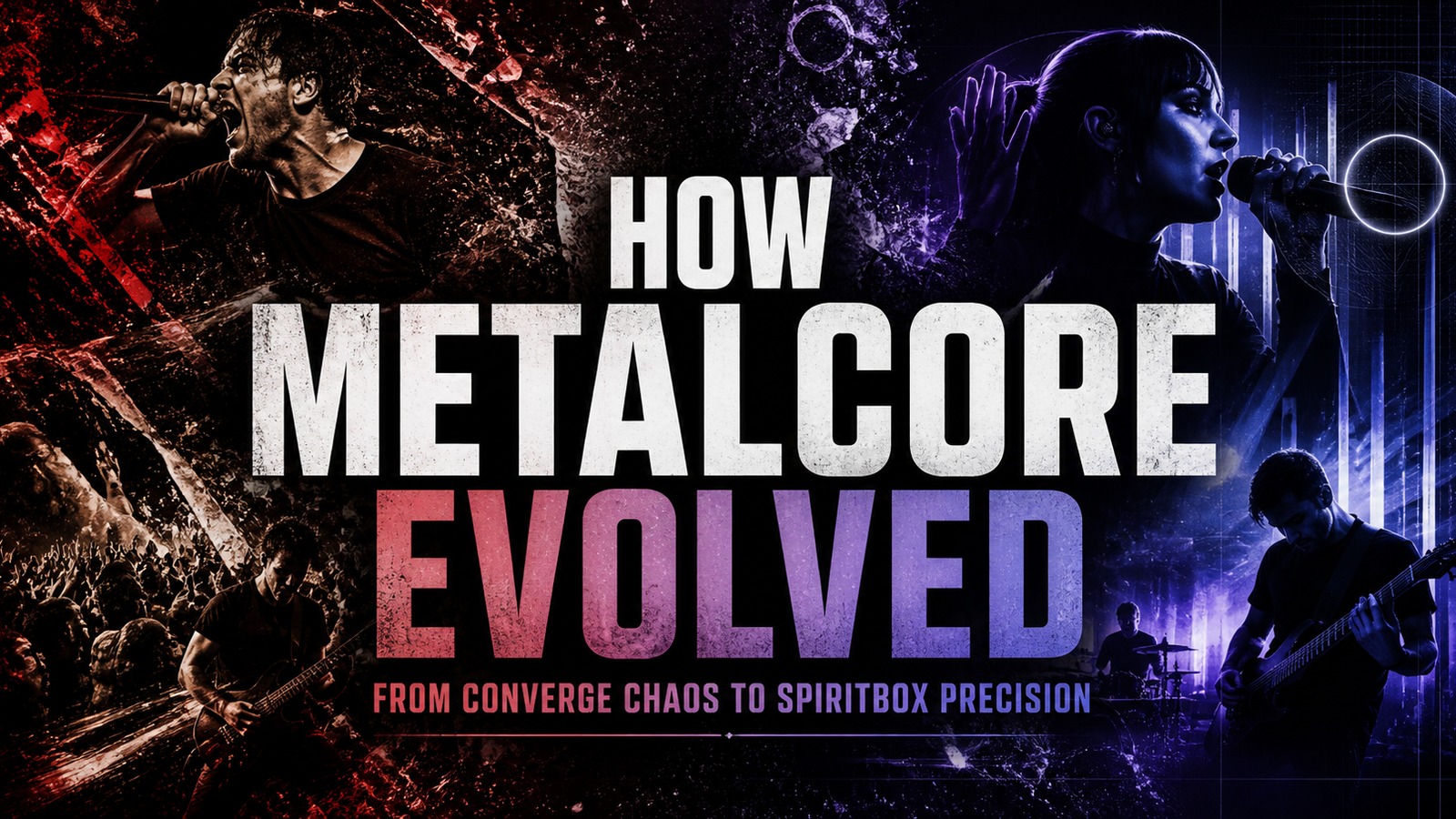
Metalcore did not evolve by getting smoother. That is the lazy version. The real story is uglier and more useful: hardcore kids dragged metal riffs into rooms that did not care about guitar hero manners, metal kids learned that breakdowns could hit harder than solos, and every generation afterward fought over how much melody, polish, electronics, and ambition the genre could survive.
That fight is why Converge and Spiritbox can both sit under the same broad banner without sounding like they were built for the same planet. One treats collapse like a language. The other turns pressure, space, and precision into something almost architectural. The line between them is not clean, but it tells you a lot about how metalcore became one of heavy music's most flexible and most argued-over forms.
Before Metalcore Had a Uniform
Before the genre had merch-table fonts and chorus formulas, it was a collision. Hardcore already had speed, ethics, and bodies flying into bodies. Metal had weight, riff craft, and a longer relationship with darkness. The early metalcore idea was not "put a clean chorus after a breakdown." It was, more bluntly, what happens when hardcore's physical urgency gets fed through metal's heavier vocabulary.
The earliest important metalcore records can feel less like genre blueprints and more like stress events. Earth Crisis brought militant straight-edge hardcore into heavier, metallic shapes. Integrity made everything feel more apocalyptic. Shai Hulud put emotional and philosophical intensity inside music that refused to behave like simple punk or simple metal.
Then Converge sharpened the blade.
Converge did not make metalcore safe, and that is the point. Records like Jane Doe are still hard to domesticate because they do not offer the listener many handles. The riffs convulse. The vocals sound torn out rather than performed. The songs move like panic with discipline underneath it. Converge proved that metalcore could be art-damaged, violent, personal, and structurally fearless without asking radio or festival bills for permission.
That strain never went away. You can hear its ghost in mathcore, chaotic hardcore, grind-adjacent bands, and every modern act that treats breakdowns as emotional rupture instead of a dance move. Metal Mantra covered Converge's ongoing relevance when the band announced its second 2026 album, Hum of Hurt, and that story matters here because Converge are not just a historical checkpoint. They are still active evidence that the chaotic branch has teeth.
The Melodic Breakthrough Changed Everything
The early 2000s turned metalcore into a bigger room. Killswitch Engage, Shadows Fall, Unearth, God Forbid, As I Lay Dying, and their peers took Swedish melodic death metal influence, hardcore breakdowns, and cleaner songwriting instincts and made the genre legible to a much larger audience.
This is where a lot of fans first met metalcore: harmonized guitar lines, screamed verses, huge clean choruses, pit parts placed with purpose, and production that still had muscle but no longer sounded like a basement fight recorded through a wall.
Killswitch Engage were the central gateway. They did not invent the ingredients, but they made the balance feel obvious. Suddenly a metalcore song could be brutal enough for the floor and memorable enough for the ride home. Howard Jones gave the genre one of its defining voices, and Adam Dutkiewicz helped establish a production and songwriting language that dozens of bands chased.
This was also the era when metalcore became a commercial pipeline. Ozzfest, Warped Tour, Headbangers Ball, festival side stages, soundtrack placements, and guitar magazines all helped push the sound beyond local scenes. The upside was reach. The downside was imitation. Once the formula worked, too many bands treated the formula as the genre itself.
Still, the melodic wave is not a sellout footnote. It is the reason metalcore became a shared language instead of a niche argument. Without that bridge, the later explosion does not happen.
MySpace Metalcore Made the Sound Messier and Bigger
The next wave did not ask permission from purists. It showed up with neon merch, haircuts, synth stabs, crabcore jokes, and enough breakdowns to make message-board lifers furious.
Bring Me The Horizon, The Devil Wears Prada, Attack Attack!, Asking Alexandria, Of Mice & Men, We Came As Romans, Miss May I, and a flood of scene-era bands pushed metalcore into internet-native territory. Some of it aged rough. Some of it was sharper than people admitted at the time. All of it mattered because it changed the culture around the music.
Metalcore became social. It became visual. It became a youth identity again, not just a sound. Production got brighter. Choruses got bigger. Electronics crept in. Deathcore bled into the edges. Pop instincts started sneaking through the side door.
That era also created the backlash that still shapes metalcore discourse. Fans who came in through Converge or Killswitch heard the scene wave as dilution. Younger fans heard it as ownership. Both reactions make sense. The genre was mutating in public, and nobody agreed on who had the right to define it.
Atreyu sit in that argument in a different way. The band helped turn emotional metalcore into something massive in the 2000s, then kept changing long after the old scene map stopped making sense. Metal Mantra dug into that tension in Beartooth, Atreyu, and the Great Metalcore Escape, because the question was never just whether bands got softer. It was whether bands could grow without erasing the thing that made fans care in the first place.
Djent, Atmosphere, and the Post-Genre Push
By the 2010s, another shift was underway. Metalcore started absorbing djent precision, ambient space, prog-metal structure, and electronic production with more seriousness. Architects, Northlane, Erra, Invent Animate, Volumes, Veil of Maya, and later Bad Omens and Sleep Token-adjacent conversations all pushed the sound away from one fixed template.
Architects are the obvious hinge. Their run from Hollow Crown through All Our Gods Have Abandoned Us turned grief, technical rhythm, and huge emotional architecture into a new kind of metalcore gravity. The riffs were tighter. The production was cleaner. The choruses were bigger, but the weight came from tension as much as brute force.
Northlane pushed atmosphere and electronics further. Erra made technical beauty feel central instead of ornamental. Invent Animate brought a colder, dreamlike edge. Even bands that moved away from strict metalcore kept borrowing its mechanics: the drop, the panic, the release, the enormous chorus after the pressure valve opens.
This is where the genre's flexibility became impossible to deny. Metalcore was no longer one sound. It was a toolkit.
That toolkit could build arena rock, progressive metal, electronic heaviness, deathcore hybrids, or something closer to hardcore with modern production. The fights got louder because the borders got weaker.
Spiritbox and the Modern Control Room
Spiritbox did not arrive as a random hype event. They landed because metalcore had spent decades making room for a band like them.
Courtney LaPlante's vocals can move from intimate to monstrous without treating either side like a gimmick. Mike Stringer's guitar work understands weight, silence, and texture. The band uses electronics and atmosphere without sanding off the impact. Their songs can be sleek, but they are not harmless.
That is the key difference between modern polish and empty polish. Spiritbox are controlled, not sanitized. The violence is still there. It is just framed with more space around it.
Where Converge often sound like the room is coming apart, Spiritbox sound like the room was designed to crush you at the exact right second. That is not a moral ranking. It is evolution through different priorities.
Metalcore needed Converge to prove chaos could be art. It needed Killswitch Engage to prove melody could carry weight. It needed the scene era to prove kids could take ownership even when older fans hated the packaging. It needed Architects and Northlane to prove atmosphere and precision could deepen the impact instead of weakening it. Spiritbox are one of the clearest modern results of all those arguments.
The Genre Is Strongest When It Keeps Arguing
Every few years someone declares metalcore dead, fake, too polished, too commercial, too soft, too technical, or too far from hardcore. The complaints are not always wrong. They are just incomplete.
Metalcore has always been unstable. That instability is the engine. The genre works because it can fight with itself and keep producing new shapes. Some branches should stay ugly. Some should chase hooks. Some should sound like hardcore bands with better amps. Some should sound like machines having a panic attack in a cathedral.
The only useless version is the one that forgets tension.
If you are building a shelf around the genre's main eras, start with the records that mark the fault lines: Converge's Jane Doe, Killswitch Engage's Alive or Just Breathing and The End of Heartache, Architects' All Our Gods Have Abandoned Us, Northlane's Alien, and Spiritbox's Eternal Blue. Current physical editions and related releases are worth checking through metalcore album searches on Amazon.
For a cleaner entry point, Metal Mantra's best metalcore albums for beginners covers the records that make the genre easier to map without pretending it was ever tidy.
The path from Converge to Spiritbox is not a straight line. It is a pit that kept widening until the walls stopped holding. Metalcore still matters when the best versions sound like a scene arguing itself into the future.