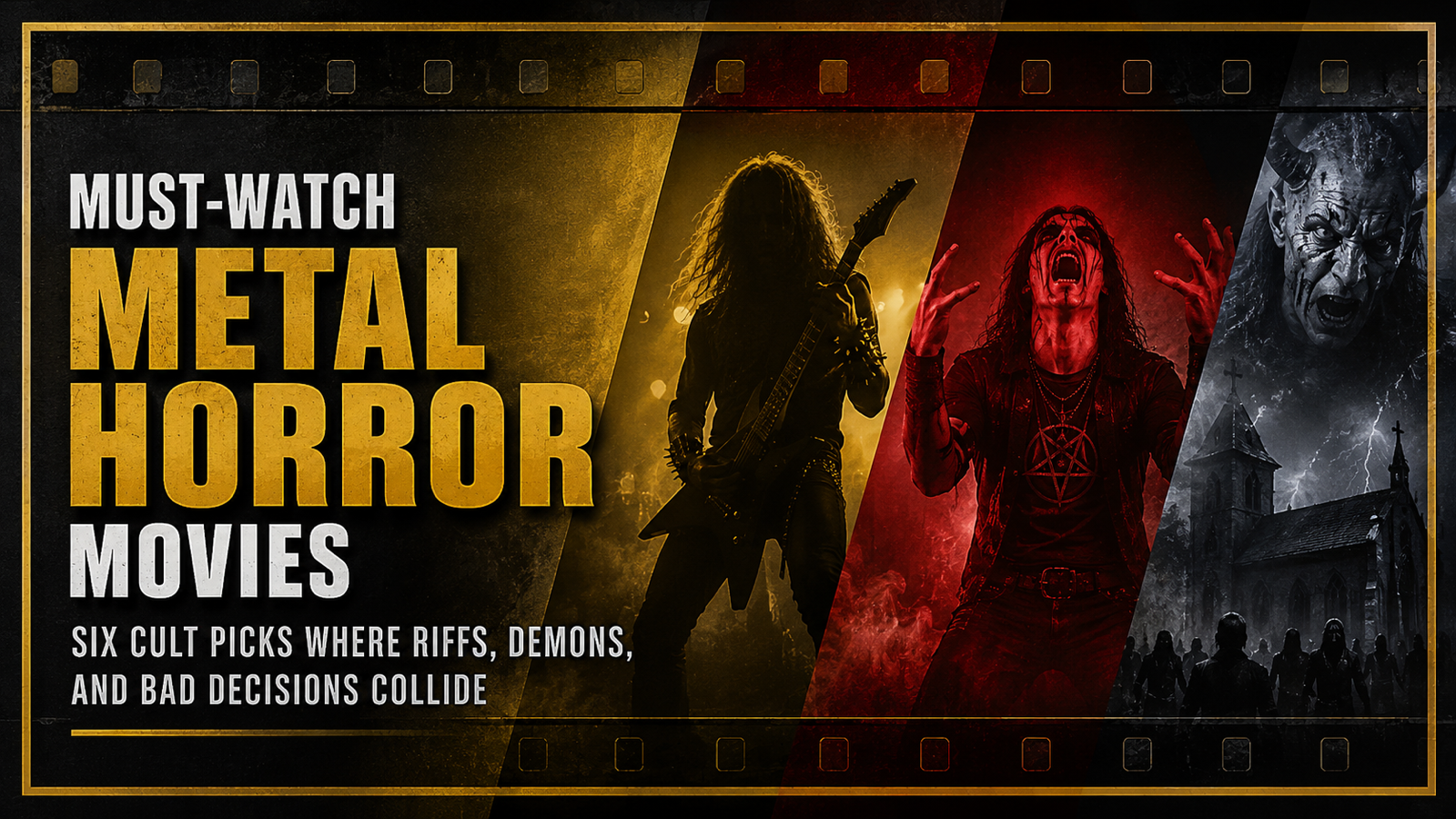
Metal horror is easy to fake and hard to get right. A movie can throw a pentagram on a poster, put a leather jacket on the lead, and blast a distorted guitar cue over the credits. That does not make it metal. It makes it a costume with a rented amp.
The good ones understand something more specific: heavy music can be a refuge, a threat, a joke, a teenage identity crisis, and a portal to terrible decisions, sometimes in the same scene. These six picks are not ranked by prestige. They are here because metal is built into the engine of the movie, whether that means a cursed record, a demonic stage act, a vampire soundtrack, or a band chasing fame straight into the fire.
If you want the cleaner documentary side of heavy music, start with our best metal documentaries streaming guide. This list is for the nights when the fog machine wins.
Trick or Treat (1986)
If metal horror has a house classic, this is it. Trick or Treat follows Eddie "Ragman" Weinbauer, a bullied metal kid who mourns the death of his hero, Sammi Curr, then discovers that playing Sammi's unreleased record backward is not just teenage ritual. It is an invitation.
The movie works because it is not laughing at Eddie from the outside. The room matters. The posters matter. The record matters. Anyone who ever treated a favorite band like armor understands why Eddie falls so hard for Sammi's myth. That is also why the horror lands: the thing that helped him survive school turns around and starts asking for payment.
Tony Fields gives Sammi Curr the right kind of rock-star menace, more undead arena creep than cartoon Satanist. Gene Simmons appears as radio DJ Nuke, and Ozzy Osbourne gets the best joke in the room as an anti-metal televangelist. The movie knows exactly what moral panic sounded like in the '80s, then flips it into a revenge fantasy with smoke, sparks, and a cursed acetate.
This is the first one to watch because it treats metal fandom as the story, not decoration. Eddie is not a generic horror lead with a taste in loud music. He is a metalhead before the plot starts, and the plot punishes him through the thing he worships.
Black Roses (1988)
Black Roses is less subtle, and that is part of the point. A mysterious hard rock band rolls into a small town, parents panic, teenagers pack the shows, and the music starts turning kids into monsters. The title band is not a metaphor hiding in the corner. They are the threat, the bait, and the punchline.
The film lands best when watched as a time capsule of adult fear. It is every "rock music is corrupting our children" sermon pushed into creature-feature territory. The parents are stiff, the kids are ready to mutiny, and the band plays like they know the town was already one bad chorus away from collapse.
John Fasano directs it with the patience of someone who understands that the performance scenes are the sell. The songs are big, glossy, and sleazy enough to justify why the teens would buy in. When the horror breaks loose, it does not feel imported from another movie. It feels like the stage show finally stopped pretending.
No, Black Roses is not elegant. That is not the job. Its job is to take the old "devil music" accusation literally and have fun with the absurdity. For a double feature, run it after Trick or Treat and watch how differently both movies use the same cultural panic.
Queen of the Damned (2002)
Queen of the Damned is the nu-metal vampire movie people still argue about because the soundtrack became bigger than the film's reputation. That matters. The movie's version of Lestat does not just become a vampire celebrity. He becomes a heavy music frontman, and the whole thing is drenched in early-2000s goth club gloss.
Jonathan Davis of Korn helped shape the film's musical identity with Richard Gibbs, and the soundtrack pulled in the era's heavy voices around that atmosphere. Even when the movie gets messy, the music gives it a center. It sounds like a specific cultural moment: black vinyl pants, low-tuned riffs, industrial polish, and a vampire mythos trying to pass through modern rock radio.
That is why it belongs here. Queen of the Damned may not be the cleanest Anne Rice adaptation, but it understands the seduction side of heavy music better than many more respected films. The concert scenes are not background filler. They are how Lestat announces power, appetite, and ego.
For readers already tracking Korn's long shadow over modern heavy music, our piece on the band's 40-song album sessions gives useful context for how deep that creative machine still runs.
The Gate (1987)
The Gate is a suburban nightmare built around one of the purest metal-kid premises in the genre: a record, a ritual, and a hole in the backyard that should have been left alone. Stephen Dorff plays Glen, but Louis Tripp's Terry is the metalhead nerve center. Terry has the jacket, the records, the occult curiosity, and the kind of confidence that comes from knowing exactly which album cover looks like forbidden knowledge.
The genius of The Gate is scale. It does not need a stadium or a superstar demon. It turns a kid's room, a turntable, and a neighborhood yard into enough trouble. The metal element feels like a childhood rumor that became physical. You can see why a record would seem powerful to kids who already believe adults are missing the whole point.
The film also avoids one of the laziest traps in metal horror. Terry's music taste is not just a warning label slapped on a doomed kid. It is part of how he reads the world. The problem is not that he likes heavy music. The problem is that he is young enough to think every dark symbol is an instruction manual.
That distinction keeps The Gate from feeling like a scolding. It is scary because curiosity opens the door, not because the riff itself is evil.
American Satan (2017)
American Satan is the modern entry here, and it earns the slot by understanding a different metal-adjacent fear: ambition. The movie follows The Relentless, a young band that heads to Los Angeles and gets pulled into a fame bargain with obvious consequences. Subtlety is not the lane. This is a rock-and-horror morality play with eyeliner, industry rot, and a very direct view of what the machine wants from young artists.
Andy Biersack of Black Veil Brides gives the film its real scene connection, with Ben Bruce of Asking Alexandria also in the mix. That matters because American Satan is not trying to recreate the '80s Satanic panic. It is built from a later generation's anxieties: image, streaming-era visibility, addiction, betrayal, and the pressure to turn pain into product.
The music is also closer to the post-hardcore and modern hard rock ecosystem than old-school metal purists may want, but that is exactly why the movie has its audience. It reflects a lane where theatrical rock, Warped Tour culture, and horror imagery were already speaking the same language.
For more on Biersack's main band in a current heavy context, see our coverage of Black Veil Brides' Vindicate album announcement and Vindicate review.
Shocker (1989)
Wes Craven's Shocker is not a metal movie in the same fan-identity sense as Trick or Treat or The Gate. Its metal credentials come from the soundtrack choices. The movie's killer, Horace Pinker, becomes an electrical supernatural threat, and the film surrounds that high-voltage nastiness with a late-'80s hard rock and metal compilation built to sell the charge.
Megadeth's cover of Alice Cooper's "No More Mr. Nice Guy" is the obvious anchor. The soundtrack also features names tied to the hard rock and metal ecosystem of the era, giving Shocker a nastier commercial edge than a standard horror score would have provided. It feels like a studio understood that Craven's premise needed volume, not just strings.
The movie itself is uneven in the way plenty of late-'80s horror sequels and near-franchises are uneven: big concept, wild swings, some choices that work better at midnight than in daylight. But that is part of its charm. Shocker plays like a cable-channel dare from a period when horror and heavy music were both being blamed for corrupting the suburbs.
Watch it for the collision. Craven brings the nightmare logic, the soundtrack brings the amp stack, and the whole thing becomes a reminder that metal horror does not always need a band on screen. Sometimes the right song in the right ugly movie is enough.
The Fast Buying Guide
If you are building a physical stack, start with Trick or Treat, Black Roses, and The Gate. That run gives you the cursed-record angle, the demonic-band angle, and the kid-with-a-dangerous-album angle without repeating the same trick three times. Add Queen of the Damned when you want the nu-metal vampire hangover. Add American Satan when you want the modern industry-fable version. Add Shocker when the soundtrack matters as much as the plot.
For quick availability checks, use Amazon searches for Trick or Treat, Black Roses, Queen of the Damned, The Gate, American Satan, and Shocker. Availability moves around, especially with older cult titles, so check format and region before buying.
The common thread is simple: the strongest metal horror movies do not treat heavy music as a prop. They understand how a song, a logo, a record, or a stage persona can become identity first and danger second. That is why these six still work after the shock value wears off.