Metallica released Load on June 4, 1996, and 30 years later the album still does the thing a lot of cleaner legacy records cannot: it starts an argument before the first riff even lands.
That is why it remains useful. Not because every track justifies its runtime. Not because the eyeliner, Anton Corbijn visual reset, and blues-rock swing were secretly some flawless master plan. Load matters because it caught the biggest metal band on earth refusing to act like the job was to remake Master of Puppets, ...And Justice for All, or even the Black Album in a safer jacket.
Plenty of fans heard betrayal. Plenty heard freedom. The better answer is uglier and more interesting: Load is Metallica finding out how much of its audience loved the band, and how much loved a fixed idea of what Metallica was supposed to be.
The official Metallica discography still lists Load plainly: released June 4, 1996, sitting between the self-titled 1991 monster and 1997's ReLoad. On paper that makes it the follow-up to the album that turned Metallica into a global hard-rock machine. In practice, it was the first real test of what that machine could do after it had already conquered radio, arenas, MTV, and the casual listeners who had never owned a patch vest in their lives.
The band did not answer by going faster. They went wider.
The Shock Was Not Just the Hair
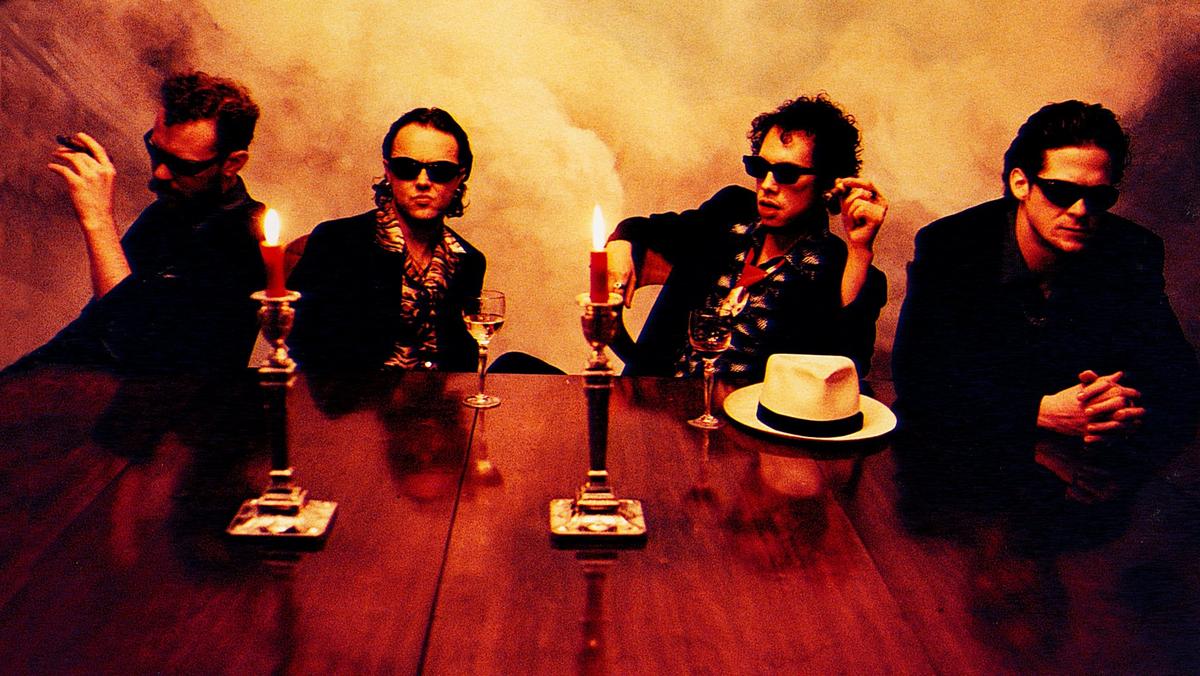
The easy version of the Load story is cosmetic: haircuts, makeup, expensive photography, different clothes, less thrash. That version is not wrong, but it is too small.
Metal fans read visual choices as declarations. In 1996, Metallica were not just changing their look. They were changing the social contract. The band that had once made underground seriousness feel gigantic was now leaning into blues riffs, Southern rock weight, loose grooves, and choruses that sounded less like precision weapons and more like burned-out confessionals.
That hit harder because Metallica had already crossed over. The Black Album did not merely sell. It redrew the map. It taught labels that a metal band could move like a mainstream institution without completely sanding off its danger. By the time Load arrived, the old argument was not whether Metallica could get bigger. They already had. The argument was whether getting bigger had changed what the band owed its first audience.
Metallica's answer was blunt: less than that audience thought.
You can hear it in "Ain't My Bitch," which opens the record with swagger instead of speed. The riff is not trying to win a downpicking contest. It is trying to move. "2 X 4" doubles down on that bar-band stomp, while "The House Jack Built" pulls the record into slower, stranger air. "Until It Sleeps" remains the cleanest proof of concept: compact, melodic, dark, and built around tension rather than speed. It is not thrash disguised as radio rock. It is Metallica admitting that menace can sit inside restraint.
That move still bothers people because it was not timid.
The Best Songs Got Older With the Audience
The older Load gets, the more the record's strongest material separates from the period drama around it.
"Bleeding Me" is the big one. It is too patient to work as a nostalgia shortcut and too heavy emotionally to dismiss as a soft-rock detour. James Hetfield does not bark through it like a conqueror. He sounds pinned under the thing he is describing, and the band gives him room to sit there. The track builds by pressure, not by technical escalation, which is exactly why it has lasted.
"The Outlaw Torn" belongs in the same conversation. Metallica had written long songs before, obviously, but this one does not move like the classic epics. It stretches. It aches. It lets Kirk Hammett and Lars Ulrich work inside a looser architecture while Jason Newsted holds the song to the ground. It is not the sound of a band trying to outrun itself. It is the sound of a band trying to live inside a wound without turning it into a race.
That matters when you line Load up against the band's larger history. Metal Mantra has covered the modern stadium version of the band, from Metallica's Levi's Stadium M72 run to the ongoing machinery around Metallica's Sphere era. Those versions of Metallica are almost impossibly scaled: massive production, no-repeat setlists, a catalog big enough to function like its own city.
Load is not that. It is more human than monumental. Sometimes that makes it better. Sometimes it makes it frustrating.
"Hero of the Day" still feels like a band testing how far vulnerability can go before the old guard turns its back. "King Nothing" is the closest the record comes to a classic Metallica sneer, and even then it is riding a groove that belongs more to hard rock than thrash. "Mama Said" remains the clearest line in the sand. Country shading from Metallica was never going to pass quietly in 1996, and it still sounds like the kind of move a less powerful band might not have survived.
Metallica survived it because they were Metallica. That does not mean every choice worked. It means the argument became part of the catalog.
The Record Is Overlong, and That Is Part of the Truth
Defending Load does not require pretending it is lean.
Fourteen songs is a lot for this version of Metallica, especially when the record is built on mood, groove, and mid-tempo force instead of the sharp contrast that powered the earlier classics. There are tracks here that would hit harder with less surrounding them. There are stretches where the looseness starts to feel less like confidence and more like nobody wanted to make the hard cut.
That is the record's biggest flaw. It is not that Metallica changed. It is that they changed and then left almost every argument in the room.
But that sprawl also tells the truth about the moment. Load does not sound focus-grouped. It sounds like a band with enough power to let the experiment run long. That makes it uneven. It also keeps it from feeling like a calculated brand pivot dressed up as rebellion.
The production is a huge part of why the album still works in places where later, heavier records sometimes do not. The guitars have weight without choking the songs. The drums breathe. The bass has presence. Hetfield's voice sits forward in a way that makes the emotional material harder to dodge. If you are revisiting the album today, do it on a decent system or with headphones rather than through phone speakers. The record is not built for tiny playback.
For anyone replacing a battered copy or finally putting it on the shelf, Metallica's Load is searchable on Amazon. Just do not buy it expecting the old thrash contract. That contract was already dead when the album came out.
Metallica Did Not Kill Themselves Here
The laziest take on Load is that it killed Metallica as a metal band. That only works if you ignore everything that came after.
The band continued to mutate, sometimes badly, sometimes brilliantly. ReLoad extended the same writing era with a different balance. St. Anger turned internal collapse into a famously hostile document. Death Magnetic, Hardwired... To Self-Destruct, and 72 Seasons all wrestled with the classic Metallica vocabulary in different ways. The live band, meanwhile, kept absorbing every era into the setlist until the catalog stopped behaving like a straight line.
That is why Load is more than a weird middle chapter. It is the album that made later Metallica possible by proving the band could violate expectation and still remain recognizably itself.
Not everyone has to like that. Some fans will always hear Load as the moment Metallica stepped away from what made them essential. Fair enough. If your Metallica begins and ends with the first four records, this album was never going to feel like home.
But 30 years later, the better question is not whether Load is "metal enough." That question has been exhausted. The better question is whether the songs still reveal something about the band that the safer path would have hidden.
They do.
Load revealed a Metallica that wanted swing, space, melody, discomfort, and adult damage. It showed Hetfield writing from a place less armored than the old battle stance. It showed Hammett leaning into color as much as attack. It showed Ulrich chasing arrangement drama over pure velocity. It showed Newsted inside a band that was widening faster than anyone outside the room could really process.
That is why the record still gets under people's skin. Bad albums usually stop offending people after a while. They fade into the shelf. Load never fully did. It remains too successful to dismiss, too flawed to canonize cleanly, too important to skip, and too strange to flatten into either "sellout" or "secret masterpiece."
Thirty years on, that is the real verdict: Load did not kill Metallica. It killed the illusion that Metallica belonged to one version of metal forever.